
If you are looking for a complete, step-by-step resource to understand how apna khet apna rozgar apply online punjab works, this is the most detailed and accurate guide available in 2026. The AKAR Scheme, officially launched by Chief Minister Maryam Nawaz Sharif, represents one of the most transformative rural development programs in Pakistan’s recent history — one that goes far beyond traditional welfare by giving landless families the tools, land, and training to build generational wealth through agriculture.
What Is the AKAR Scheme and Why Was It Launched?
Punjab’s rural communities have long struggled with a single, deep-rooted problem: they work the land but they do not own it. Rising inflation, expensive farming inputs, and a lack of resources have pushed thousands of landless families deeper into poverty with every passing year.
To fix this problem at its root, Punjab Chief Minister Maryam Nawaz Sharif formally inaugurated the “Apna Khet, Apna Rozgar Scheme,” aimed at boosting agricultural and economic prosperity in the province. Under the scheme, agricultural land worth around 160 billion rupees will be provided to landless villagers. A total of 88,780 families will benefit from 13,812 agricultural plots across Punjab, while 101,111 families will receive 16,685 plots in Cholistan.
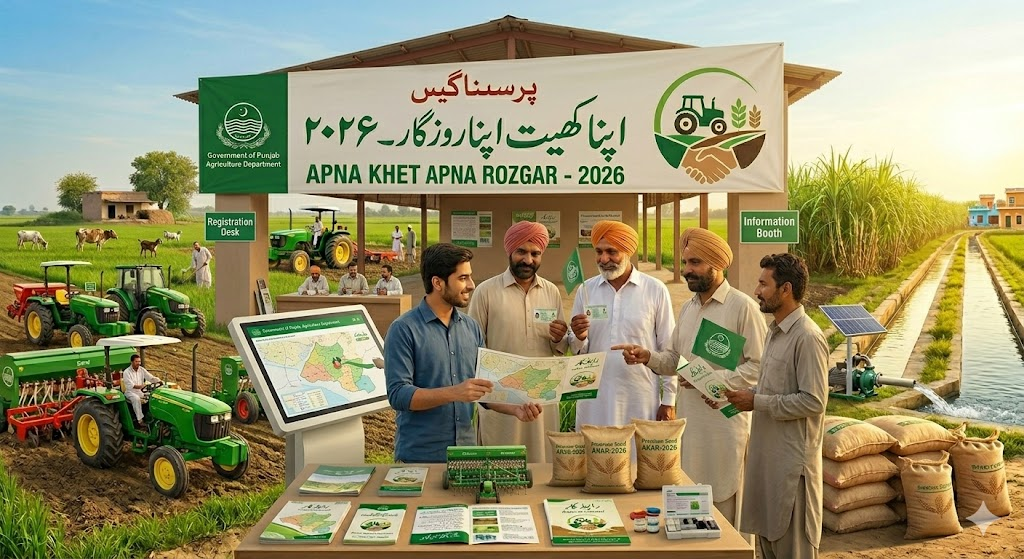
The Apna Khet Apna Rozgar 2026 Scheme is a flagship agricultural empowerment initiative launched by the Government of Punjab under Chief Minister Maryam Nawaz Sharif. The program aims to provide 3 to 5 acres of free agricultural land to landless farmers and unemployed rural youth across Punjab. This initiative is designed to reduce poverty, increase agricultural productivity, and transform landless laborers into self-reliant farmers through land ownership, financial access, and machinery support.
When you complete apna khet apna rozgar apply online punjab, you are not simply applying for temporary aid. You are applying for access to a complete support system — land, machinery subsidies, agricultural training, market connections, and financial tools through the Kisan Card — all packaged into one comprehensive initiative.
Punjab is widely recognized as the agricultural backbone of Pakistan. Despite this, many rural families still do not own land. Skilled agricultural workers often rely on seasonal labor work with unstable earnings. This limited income makes it difficult for families to maintain long-term financial security.
The AKAR Scheme directly addresses that gap. The name itself — “Apna Khet, Apna Rozgar” — translates to “Your Own Field, Your Own Livelihood,” and that philosophical foundation runs through every feature of the program.
The Vision Behind the Scheme: More Than Just Land
What makes this scheme revolutionary is that you don’t just get land and good wishes. The government provides everything you need to become a successful farmer — from quality seeds to modern tractors, from expert training to market access. It’s a complete transformation package.
The AKAR offers multiple economic and social benefits. Instead of depending on daily wage labor, beneficiaries can cultivate their own land and earn independently. Land ownership access allows families to secure long-term income sources, reducing financial instability. By bringing idle land into active farming use, overall crop production in Punjab will increase. Young people in rural areas will get a chance to build careers in agriculture. When farmers earn more, local markets, transport services, and related industries also grow. Higher agricultural output contributes to better food availability at provincial and national levels.
Understanding this broader vision is essential before you begin the apna khet apna rozgar apply online punjab process. The government is not distributing charity — it is creating the infrastructure for self-sufficient agricultural households across all 36 districts of Punjab.
Rural unemployment will decline. Agricultural GDP contribution may increase. Migration from villages to cities could reduce. Sustainable farming practices may expand. This program aligns with broader agricultural development strategies aimed at modernizing farming in Punjab.
The scheme has been announced as part of CM Maryam Nawaz Sharif’s broader rural reform agenda, which also includes the Green Tractor Scheme, the CM Punjab Kisan Card, the Apni Chhat Apna Ghar housing initiative, and various interest-free loan programs designed to lift rural communities out of intergenerational poverty.
Scale and Scope: How Large Is This Program?
Before diving into the step-by-step process of apna khet apna rozgar apply online punjab, it is important to appreciate the sheer scale of this initiative so you understand what you are competing for and why preparation matters.
This program commits the Punjab government to distributing 250,000 acres of state-owned agricultural land to deserving, landless citizens across all districts of Punjab.
A total of 43,938 areas have been identified across various districts, while 83,425 areas in Cholistan have been marked, keeping irrigation and fertility factors in view. Agricultural land will be identified based on water availability and soil fertility, and each successful applicant will receive agricultural land worth Rs 2.5 million to Rs 4 million for cultivation. Additionally, a one-time development grant ranging from Rs 50,000 to Rs 250,000 per acre will be provided to support land preparation.
The AKAR Scheme offers landless Pakistani farmers 3–10 acres of government land on a 10-year lease at just Rs 100/acre annually, launched by CM Maryam Nawaz Sharif. This program benefits 50,000 families through transparent computerized balloting.
In Cholistan specifically, which has historically been an underutilized agricultural frontier, the program is expected to unlock enormous productive potential. The Punjab Land Records Authority (PLRA) has been actively involved in identifying and mapping state-owned land across all tehsils for fair and transparent distribution.
The land will be leased for 10 years strictly for farming purposes with a ban on permanent construction. This condition is crucial — the government wants the land to remain in active agricultural use, not become a vehicle for real estate speculation.
Official Application Timeline for 2026
Applicants can apply online from May 2 to May 18. Candidates will have the option to file appeals with the Deputy Commissioner between June 1 and June 8. The final list will be issued on June 19, and land distribution will commence from June 30.
This tight timeline means that anyone serious about completing apna khet apna rozgar apply online punjab must move quickly and ensure all documents are ready before the portal opens. Late submissions are typically not accepted under any circumstances. endbugflow, Feed by way, connecting to wifi, viral manners, networth.
CM Punjab Maryam Nawaz Sharif has started the online portal akar.pulse.gop.pk on the PLRA official website to receive online application forms. The Apna Khet Apna Rozgar Scheme Application Form enables eligible applicants to apply for agricultural support and financial assistance. It collects personal, land, and income details to assess eligibility and process benefits transparently.
It is important to note that the helpline number 042-111-111-111 has been designated for any queries related to the scheme. Additionally, the government helpline 0800-15000 and 0800-29000 are available for those who need assistance during the registration process.
Who Is Eligible? Complete Eligibility Criteria
Understanding who qualifies is the most critical step before you attempt apna khet apna rozgar apply online punjab. Submitting an ineligible application wastes time and may result in disqualification from future phases.
Nationality and Residency Requirements
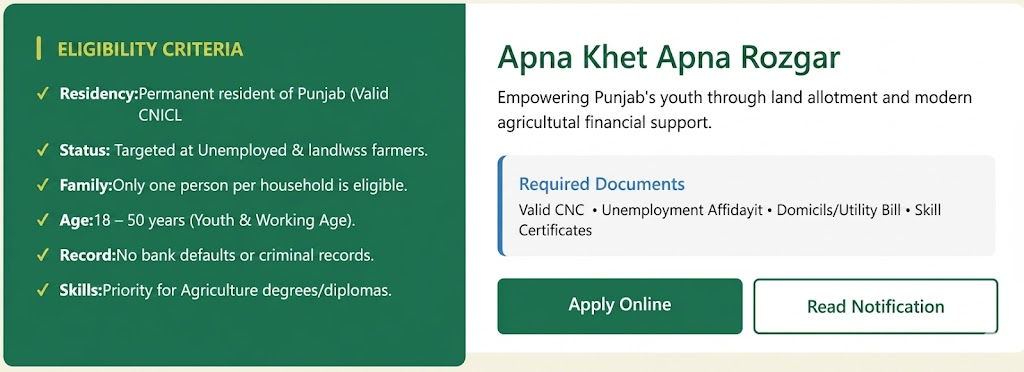
Applicants must be permanent residents of Punjab. Valid proof such as domicile or address verification may be required during the Akar program online registration process. Individuals residing outside Punjab are not eligible under this provincial scheme. A valid Computerized National Identity Card is compulsory. Applicants with expired, blocked, or invalid CNIC records may not qualify until their documentation is updated.
Land Ownership Status
Eligible applicants must be landless or own maximum 10 marlas residential property, be permanent residents of the revenue estate, and have no prior government allotments.
Small farmers with up to a limited acreage (usually under 12.5 acres) may still be eligible depending on the category, but completely landless individuals get higher priority for fresh land allocation.
Age and Income Criteria
Soon, citizens of Punjab aged 18 to 50 years whose background is farming can apply online. Preference will be given to unemployed youth and low-income families.
Low-income families and households facing financial hardship are expected to receive preference. The program focuses on economically vulnerable individuals who genuinely need support under the broader CM Punjab subsidy scheme and government agriculture subsidy framework.
Agricultural Background
The main objective of the AKAR Program Punjab is to support those who have agricultural skills but do not have access to land or sufficient financial resources to start farming independently. Through the official portal, priority is given to applicants who can actively use farmland to generate income and build long-term financial stability. Landless farmers currently working on rented or others’ land, unemployed rural youth looking for self-employment in agriculture, and agricultural laborers with practical farming experience are the primary target beneficiaries. apna khet apna rozgar scheme 2026
Gender Inclusion
Both men and women can apply, including widows, divorced women, or disadvantaged applicants.
Women are fully eligible and encouraged to apply. Widows, single mothers, and women who are the main earners in their household are given favorable consideration during selection.
This strong gender-inclusive approach makes the AKAR program one of the most progressive rural welfare schemes in Pakistan’s history. Women who have traditionally been excluded from land ownership and agricultural credit are now prioritized in this initiative.
Farming Commitment
Applicants must clearly intend to use the allocated land for farming purposes only. Commercial resale, transfer, or misuse of land is strictly prohibited. The objective of the apna khet apna rozgar apply online punjab process is to create sustainable agricultural livelihoods, not short-term financial gains.
Required Documents — What You Must Prepare
Proper documentation is the difference between a successful application and an immediate rejection. All documents must be current, accurate, and clear when uploaded to the portal during apna khet apna rozgar apply online punjab registration.
Here is a comprehensive list of documents you need to prepare:
Identity and Residency Documents
- Valid CNIC (Computerized National Identity Card) — must not be expired or blocked
- Punjab Domicile Certificate
- B-Form for underage dependents (if applicable)
- Proof of current residence (utility bill or tenancy agreement)
Agricultural and Land Status Documents
- Fard (land record extract) showing your current land status — or a declaration of being landless
- Agricultural background verification from the local Agriculture Extension Officer
- Lease agreement (if you are currently farming leased land)
- Family land record (if you are a small farmer applying under the small-farmer category)
Financial and Income Documents
- Income declaration or poverty certificate from the relevant authority
- Bank account details (for those who already have an account linked to their CNIC)
- Kisan Card details (if already enrolled)
Additional Supporting Documents
- Passport-size photographs
- Active mobile number registered under your own CNIC
- Proof of agricultural training or experience (if available — not mandatory but helpful)
Having complete documentation increases approval chances significantly. Applicants who submit incomplete forms, blurry scanned documents, or inconsistent information risk automatic rejection during the early screening phase.
Step-by-Step Online Registration Process
Once you have confirmed your eligibility and gathered your documents, you are ready to complete apna khet apna rozgar apply online punjab. The process is designed to be straightforward, but it requires careful attention at every stage.
Step 1 — Access the Official Portal
Go to akarpunjabgovt.pk or akar.pulse.gop.pk on your phone or computer. Make sure you are using the correct government website. This is critically important — numerous unofficial websites claim to provide registration services but are either fraudulent or simply informational. No private website or agent is authorized to collect applications or fees.
Step 2 — Create Your Account
Enter your CNIC number and active mobile number to create your login account. You will receive a verification code on your phone via SMS. This OTP-based verification ensures that only genuine applicants with valid national identity records can access the registration system.
Step 3 — Complete Your Profile
Fill in all personal details accurately — your name, address, district, tehsil, family information, and farming background. Inaccurate profile information is one of the most common reasons for application rejection. Even small inconsistencies between your CNIC data and what you enter online can trigger a flag in the automated screening system.
Step 4 — Fill the Application Form
Enter all required details in the online form, including land status, income level, employment situation, farming experience, and the type of agricultural support you are applying for. The scheme may include different support categories such as landless applicant land allocation, small farmer equipment support, and agricultural graduate assistance. Applicants must apply in the category that matches their background and farming needs. Incorrect category selection may lead to rejection.
Step 5 — Upload Required Documents
Scan and upload clear, legible copies of all required documents. Blurry images, partially visible documents, or mismatched file types are frequent causes of rejection. Use a smartphone camera in good lighting if you do not have access to a scanner. Ensure file sizes comply with the portal’s upload limits.
Step 6 — Review and Submit
Before clicking submit, carefully review every section of your application. Check your CNIC number, mobile number, address, district, tehsil, and land status information. Once submitted, applications normally cannot be changed after submission.
Step 7 — Save Your Tracking ID
After successful submission, you will receive a confirmation message on your registered mobile number. Save your tracking or reference ID, as this is how you will monitor your application status through the portal.
Step 8 — Track Your Application
You can track the AKAR scheme 2026 application status through SMS alerts or by logging into the portal. People who do not have internet access can still apply for the scheme by visiting their nearest District Agriculture Office, where officials can assist with the registration process.
Key Benefits of Participating in the AKAR Scheme
The true power of apna khet apna rozgar apply online punjab lies not just in the land allocation but in the comprehensive support ecosystem built around it. Let’s break down every benefit a selected applicant receives.
Agricultural Land Allocation
Under the Apna Khet Apna Rozgar scheme 2026, selected applicants may receive 3 to 5 acres of cultivable agricultural land. The land will be provided under a long-term conditional allotment system. Beneficiaries must use the allocated land strictly for agricultural activities and crop production.
Ownership Type: Long-term conditional allotment with potential for permanent ownership based on cultivation performance. Usage Rights: Complete cultivation rights, crop selection freedom, and harvest ownership.
One-Time Development Grant
A one-time development grant ranging from Rs 50,000 to Rs 250,000 per acre will be provided to support land preparation. This grant covers initial land leveling, irrigation infrastructure preparation, soil testing, and early input costs — removing the financial barrier that prevents most landless individuals from ever starting agriculture even when land is made available.
CM Punjab Kisan Card Integration
The Kisan Card isn’t just a plastic card — it’s your financial lifeline for successful farming. It provides direct access to agricultural credit without middlemen or commission agents, a seasonal credit facility for purchasing seeds, fertilizers, and pesticides, government-backed subsidies credited directly to your account, no interest charges on crop inputs purchased through the card, and emergency support during natural disasters like floods or droughts.
Over 400,000 farmers across Punjab are already using Kisan Cards, receiving subsidies worth billions of rupees directly without corruption or delays. Farmers report saving 30–40% on input costs.
Green Tractor Scheme Access
Modern farming requires modern equipment. The Green Tractor Scheme connected with Apna Khet Apna Rozgar provides: a tractor subsidy of up to Rs 1,000,000 on new tractors (50–65 HP models), zero-interest completely interest-free financing for land allottees, equipment support including subsidies for laser land levelers, seeders, and harvesting equipment, flexible repayment terms aligned with harvest seasons, and shared machinery access through government-owned machinery for those who don’t need individual tractors.
Thousands of young farmers have purchased tractors through subsidized financing, reducing their cultivation costs by 50% and increasing yields by 25–30% through timely operations.
Summary Table: AKAR Scheme 2026 at a Glance
| Feature | Detail |
|---|---|
| Scheme Name | Apna Khet Apna Rozgar (AKAR) |
| Launched By | CM Punjab Maryam Nawaz Sharif |
| Launch Date | February 4, 2026 (announced in Rajanpur) |
| Official Portal | akar.pulse.gop.pk |
| Application Period | May 2 – May 18, 2026 |
| Land Allocated | 3 to 10 acres per beneficiary |
| Total Land | 250,000 acres state-owned |
| Target Beneficiaries | 50,000+ families initially |
| Lease Duration | 10 years (conditional allotment) |
| Annual Lease Cost | Rs 100 per acre |
| Tractor Subsidy | Up to Rs 1,000,000 |
| Development Grant | Rs 50,000 – Rs 250,000 per acre |
| Cholistan Plots | 16,685 plots for 101,111 families |
| Punjab Plots | 13,812 plots for 88,780 families |
| Helplines | 0800-15000 / 042-111-111-111 |
| Application Fee | Completely Free |
| Districts Covered | All 36 districts of Punjab |
| Selection Method | Transparent Computerized Balloting |
| Final List Date | June 19, 2026 |
| Land Distribution Start | June 30, 2026 |
Agricultural Training and Technical Support
Land without knowledge produces nothing. That’s why the scheme includes comprehensive training: free enrollment in modern farming technique workshops, water-efficient irrigation methods and drip technology training, and crop rotation planning for soil health and maximum yield.
Government-run agricultural training centers have helped farmers adopt tunnel farming, drip irrigation, and high-value crop cultivation, tripling their per-acre income in some cases.
Market Linkages
One of the most underappreciated components of the AKAR program is its focus on market access. Many small farmers in Pakistan produce good quality crops but earn poor returns because they sell through middlemen who capture most of the margin. The AKAR program includes provisions for connecting beneficiary farmers directly to wholesale markets, agricultural cooperatives, and government procurement channels, ensuring that the income from their newly acquired land actually reaches their households.
Crop Insurance and Disaster Support
The government provides crop insurance options, emergency financial support through Kisan Card, and technical assistance for recovery. Beneficiaries won’t be left stranded after one bad season.
This protection against agricultural risk is a game-changer for new farmers who might otherwise give up after a single weather event or pest outbreak.
Understanding the Land Allotment Terms
The land provided under the AKAR scheme is not sold outright. Understanding the exact terms of the allotment is essential for any applicant who completes apna khet apna rozgar apply online punjab.
The land is given on long-term conditional allotment. As long as you actively cultivate it and follow agricultural guidelines, it remains yours.
Key conditions of the land allotment:
The initial lease period is 10 years, during which the leaseholder pays a nominal fee of just Rs 100 per acre per year — essentially free. During this period, the land cannot be sold, transferred, rented out, or used for construction. Regular agricultural activities must be maintained and verified through periodic inspections by Agriculture Department officials.
After successful completion of the 10-year productive period, beneficiaries who have demonstrated consistent and productive use of their land may be eligible for permanent ownership transfer. This pathway to permanent ownership is what makes the AKAR program genuinely different from traditional lease schemes, where farmers invest years of effort only to return the land at the end of the term.
The land cannot be sold, transferred, or used for non-agricultural purposes. Any violation of these conditions can result in cancellation of the allotment and reclaiming of the land by the government without compensation.
The Cholistan Opportunity: A Special Focus Area
By converting unused state land into productive farmland, the scheme aims to create sustainable economic growth across Punjab. Nowhere is this truer than in Cholistan, the vast desert region in southern Punjab that has historically been underfarmed despite containing enormous potential agricultural land.
Under this initiative, 101,111 families will receive 16,685 plots in Cholistan. This represents a massive push to transform Cholistan from a sparsely populated pastoral region into a productive agricultural zone.
The Cholistan Development Authority has been working with the Agriculture Department to identify areas suitable for cultivation based on groundwater availability, soil fertility, and proximity to existing canal infrastructure. The AKAR scheme’s investment in Cholistan is expected to be one of the largest agricultural development initiatives in that region’s history.
Applicants from South Punjab, particularly from districts like Bahawalpur, Bahawalnagar, and Rahim Yar Khan, should specifically inquire about Cholistan land availability when they complete apna khet apna rozgar apply online punjab, as these areas may have higher land availability and lower competition compared to more densely populated central Punjab districts.
How Balloting and Selection Work
This program benefits 50,000 families through transparent computerized balloting. The selection process is designed to be completely transparent and free from political interference or corruption.
Here is how the selection process works:
Initial Application Screening
Once the application portal closes, all submitted applications undergo automated screening to verify CNIC validity, Punjab domicile status, land ownership records through the PLRA database, and income documentation. Applications that fail these basic checks are rejected at this stage.
Profile Verification
Shortlisted applications go through a more detailed verification phase involving the District Agriculture Office, the revenue department, and NADRA records. Any inconsistencies between claimed information and verified data result in disqualification.
Computerized Balloting
Selection is usually completed through a transparent balloting process announced by authorities. The balloting takes into account district quota allocations, ensuring that no single area receives a disproportionate share of benefits while other districts are left out.
Appeals Process
Candidates will have the option to file appeals with the Deputy Commissioner between June 1 and June 8. This appeals window is critical for any applicant who believes they were incorrectly disqualified due to data errors or administrative mistakes.
Final Selection and Notification
The final list will be issued on June 19, and land distribution will commence from June 30. Selected applicants receive notification via SMS on their registered mobile number. They must then complete the formal land acceptance process within the stipulated time or risk forfeiting their allotment.
Common Mistakes Applicants Make and How to Avoid Them
Thousands of eligible applicants fail to receive benefits every year not because they don’t qualify, but because they make avoidable errors during the apna khet apna rozgar apply online punjab process. Learning from these common mistakes can dramatically improve your chances.
Mistake 1: Using Unofficial Websites or Agents
No private website or agent is authorized to collect applications or fees. Using unofficial sources can result in fraud or rejection. There are numerous fake portals and “agents” who claim to be able to process applications for a fee. This is pure fraud. The official portal is completely free, and no intermediary can improve or expedite your application.
Mistake 2: Submitting Inaccurate Information
Any discrepancy between your CNIC data and the information you enter in the application form will trigger an automatic red flag. Ensure your name, father’s name, address, and CNIC number match exactly as they appear on your national identity card.
Mistake 3: Uploading Poor Quality Documents
Blurry, partially visible, or incorrectly formatted document uploads are one of the leading causes of rejection during verification. Take your time with document scanning or photography. Use good lighting and ensure all text and photograph details on your CNIC and domicile certificate are clearly visible.
Mistake 4: Selecting the Wrong Category
Applicants must apply in the category that matches their background and farming needs. Incorrect category selection may lead to rejection. If you are a landless individual applying for land allocation, do not select the equipment support category designed for small farmers who already have some land.
Mistake 5: Applying Through Expired or Blocked CNIC
Applicants with expired, blocked, or invalid CNIC records may not qualify until their documentation is updated. Renew your CNIC at the nearest NADRA office before attempting to register. This simple step can make the difference between acceptance and rejection.
Mistake 6: Missing the Application Deadline
Applications submitted after the deadline are not accepted under any circumstances. Do not wait until the last day. Server loads increase dramatically near deadlines, and technical glitches can prevent last-minute submissions.
Mistake 7: Not Saving Your Tracking ID
After submission, save your application tracking number immediately. This is your only proof of submission and your only way to monitor your application status online. Applicants who lose this number often have difficulty verifying their submission.
Mistake 8: Misrepresenting Land Ownership Status
The PLRA database is directly integrated with the application portal. Any misrepresentation of your land ownership status — claiming to be landless when you actually own agricultural land — will be detected during the automated verification phase and result in permanent disqualification from the current and future phases of the scheme.
How the AKAR Scheme Differs from Previous Punjab Agricultural Programs
To fully appreciate the significance of apna khet apna rozgar apply online punjab, it helps to understand how this program differs from earlier initiatives.
For decades, Pakistan’s agricultural policy focused on inputs — subsidizing fertilizer, electricity for tube wells, and loan schemes. The core problem — lack of productive assets — was never addressed. When you own land and have the tools to cultivate it properly, you’re not just earning income; you’re building generational wealth.
Previous programs like the Kisaan Package or traditional agricultural loan schemes provided credit but did not address the fundamental issue of land access. A landless farmer who borrows money to work someone else’s land remains dependent, vulnerable, and without long-term security regardless of how productive a season might be.
The AKAR program breaks this cycle by combining land access with the financial and technical support needed to make that land productive. Unlike older schemes, this program follows a digital-first approach, ensuring transparency and easy access.
The digital application system means that a farmer in the most remote tehsil of Punjab can complete apna khet apna rozgar apply online punjab from a smartphone without needing to travel to a city, wait in long queues, or pay an agent. This democratization of access is itself a significant policy achievement.
Integration with Broader Punjab Agricultural Reforms
The AKAR scheme does not stand alone. It is the centerpiece of a broader agricultural reform ecosystem that the Punjab Government has been building since 2024.
CM Punjab Kisan Card
Applicants who qualify under the Akar Punjab agriculture support program may also receive the CM Punjab Kisan Card, which provides several benefits to farmers. The Kisan Card eliminates the commission agent system, which has historically captured enormous value that should go to farmers. By providing direct credit and subsidy access, the card has already transformed the economics of farming for hundreds of thousands of Punjab families.
Green Tractor Scheme Phase III
The Kisan Card has become the primary identity for Punjab farmers. It links your land records directly to the tractor scheme portal, enables interest-free loans to cover the farmer’s share of the tractor cost, provides discounts on seeds and fertilizers alongside the tractor subsidy, and ensures that future cash rebates or subsidies are sent directly to the Kisan Card wallet.
Tunnel Farming and Drip Irrigation Support
The Agriculture Department has been actively promoting high-efficiency farming methods — particularly tunnel farming for off-season vegetables and drip irrigation for water-scarce areas — through its training centers. AKAR beneficiaries receive priority access to these training programs and may also qualify for subsidized tunnel infrastructure depending on the specific agricultural zone they are allocated land in.
Apni Chhat Apna Ghar Housing Scheme
Many AKAR land recipients may also qualify for housing support under the separate Apni Chhat Apna Ghar scheme, which is designed to provide low-income rural families with permanent shelter. The Punjab Government has been actively trying to ensure that these programs work in tandem rather than in isolation.
Economic Impact and Long-Term Goals
The Punjab Government has published detailed projections for the economic impact of the AKAR scheme. The Apna Khet Apna Rozgar 2026 initiative is expected to create sustainable economic growth across Punjab by converting unused state land into productive farmland.
At the macro level, distributing 250,000 acres of previously idle state land into active agricultural use is projected to add significant volume to Punjab’s crop production. Increased production stabilizes food prices, reduces import dependency on agricultural commodities, and strengthens Pakistan’s overall food security position.
At the micro level, each family that successfully receives land under the AKAR scheme effectively exits the pool of landless agricultural laborers who are vulnerable to seasonal unemployment and wage suppression. As these families become independent farmers, their purchasing power increases, which stimulates local rural economies through increased demand for goods and services.
The multiplier effects are substantial. A farming family that earns stable income from its own land is more likely to invest in children’s education, access healthcare, maintain a permanent home, and participate actively in the local market economy. These behavioral changes compound over years and generations.
How to Check Application Status After Submission
Once you have completed apna khet apna rozgar apply online punjab, monitoring your application status is important. Here are the methods available:
Online Portal Tracking
Log in to the official portal using your CNIC and registered mobile number. The portal provides real-time status updates showing where your application is in the processing pipeline — from initial submission to verification, screening, balloting, and final selection.
SMS Alerts
You can track the AKAR scheme 2026 application status through SMS alerts sent to your registered mobile number. These alerts are sent at each major stage — submission confirmation, verification completion, balloting notification, and final selection announcement.
District Agriculture Office
People who do not have internet access can still apply for the scheme by visiting their nearest District Agriculture Office, where officials can assist with the registration process. The same offices can also provide status updates for applicants who have difficulty accessing the online portal.
Helpline
The government helplines at 0800-15000 and 042-111-111-111 are available to assist applicants with status inquiries, technical errors, and documentation questions. Keep your CNIC number and tracking ID ready before calling.
What Happens After Selection?
Many applicants focus entirely on how to complete apna khet apna rozgar apply online punjab but do not plan for what happens after selection. Understanding the post-selection process helps you move quickly and avoid forfeiting your allotment.
Acceptance Notification
Selected applicants receive an official acceptance notification via SMS and can also view their selection status on the portal. This notification includes instructions for completing the formal acceptance process within a specified timeframe.
Land Survey and Acceptance
An Agriculture Department official will contact you to schedule a land survey visit. During this visit, you will be shown the specific plot allocated to you, informed of its boundaries and coordinates, and given information about water availability, soil condition, and existing infrastructure.
Documentation Completion
You must sign the formal lease agreement and submit any additional documents required for the official allotment. Bring your original CNIC, domicile certificate, and any other documents specified in the acceptance notification.
Kisan Card Registration
Selected applicants are enrolled in the CM Punjab Kisan Card program simultaneously with their land allotment. Your card will be processed and delivered to your registered address, enabling you to access agricultural credit and input subsidies immediately.
Green Tractor Scheme Application
Land allottees can access the Green Tractor Scheme, but you need to apply separately through the designated process. Being a land allottee gives you priority and better terms.
Training Enrollment
You will be enrolled in agricultural training workshops organized through the Agriculture Extension Department. These workshops cover everything from soil preparation and seed selection to irrigation management, pest control, and harvest timing.
Tips for Increasing Your Chances of Approval
With around 50,000 families expected to benefit in the initial phases and considerably more applications anticipated, competition will be significant. Here are practical steps to strengthen your application when you complete apna khet apna rozgar apply online punjab.
Ensure All Documents Are Current and Valid
Double-check that your CNIC has not expired and that your Punjab domicile is current. An expired document is an automatic disqualifier regardless of how well-qualified you are in every other respect.
Be Completely Honest About Land Status
Do not misrepresent your land ownership status. The PLRA database integration means that any false claim will be detected. Honesty about your actual situation — particularly if you are currently farming leased land or working as an agricultural laborer — often strengthens rather than weakens your application.
Provide Evidence of Agricultural Background
While not always mandatory, documentation showing your farming experience — a reference letter from an Agriculture Extension Officer, a record of crop sales, or evidence of agricultural training — can significantly improve your scoring during evaluation.
Apply During Low-Traffic Hours
Portal congestion near the application deadline is common. Apply during early morning or late night hours when fewer users are online to reduce the risk of technical errors during submission.
Keep Your Mobile Number Active
All communication — OTP verification, confirmation messages, status updates, and selection notifications — is sent to your registered mobile number. Ensure this number remains active and accessible throughout the entire process.
Attend District Information Sessions
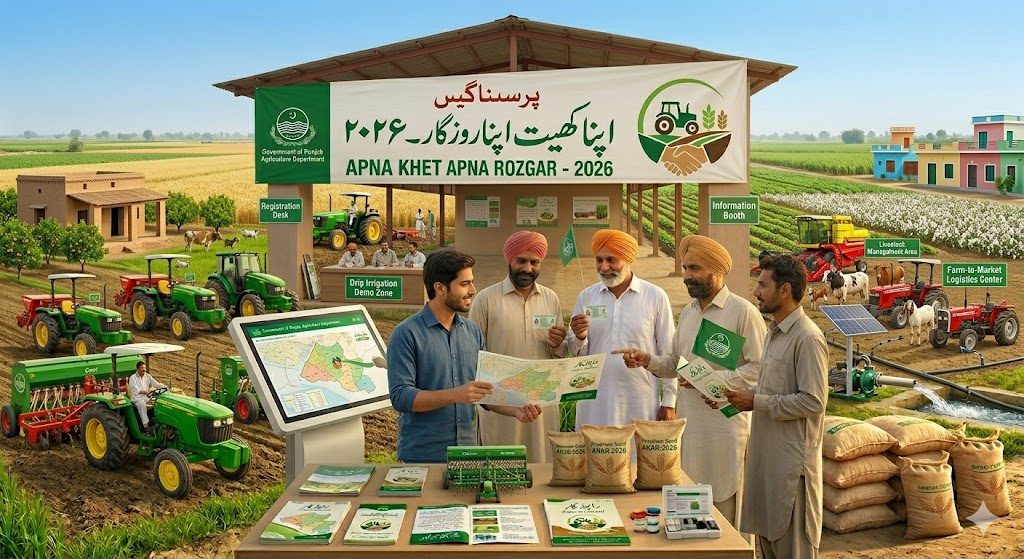
Many District Agriculture Offices organize information sessions and facilitation camps for AKAR scheme applicants. Attending these sessions ensures you have accurate, up-to-date information directly from government officials and allows you to ask specific questions about your situation.
Frequently Asked Questions
Is there any fee to complete apna khet apna rozgar apply online punjab?
The Akar program registration process is expected to remain completely free of cost. Anyone asking for payment to process or expedite your application is a fraudster. Report such individuals to the relevant District Agriculture Office or through the CM Punjab Complaint Cell.
Can someone who currently leases land still apply?
Yes, landless individuals can apply for leased land. Landowners with agricultural land less than 12.5 acres may also apply but it will be subject to availability after the allotment to landless individuals.
What is the lease duration and annual cost?
The scheme offers government land on a 10-year lease at just Rs 100 per acre annually.
Can a person who has previously received land under another government scheme apply?
Eligible applicants must have no prior government allotments. If you have previously received agricultural land from any government scheme, you are generally not eligible unless the previous allotment was returned or cancelled.
How are disputes about eligibility resolved?
Candidates will have the option to file appeals with the Deputy Commissioner between June 1 and June 8. If you believe your application was incorrectly rejected, you must file a formal appeal within this window.
Can I choose which district or tehsil my land is allocated in?
Land allocation is based on availability in your home district and is managed through the computerized balloting system. While you can indicate preferences, the final allocation depends on available state land in your area and the results of the transparent balloting process.
What crops can I grow on the allocated land?
Mostly yes, farmers can choose their own crops. However, agriculture officers assigned to your plot will guide you toward crops best suited to your land type, soil quality, water availability, and local market demand.
What happens if my crops fail due to floods or drought?
The government provides crop insurance options, emergency financial support through Kisan Card, and technical assistance for recovery. Beneficiaries won’t be left stranded after one bad season.
What if I want to leave agriculture and pursue another livelihood?
The land allotment terms require that the land be actively farmed. If you abandon cultivation, the government can reclaim the land and reallocate it to another deserving applicant. The scheme is specifically designed for individuals who are genuinely committed to building their livelihood through agriculture.
Can a woman head of household apply on behalf of her family?
Yes. Women are fully eligible and encouraged to apply. Widows, single mothers, and women who are the main earners in their household are given favorable consideration during selection.
How will I know if the portal is currently accepting applications?
The official government portal, CM Punjab social media accounts, and local District Agriculture Offices all announce when the application window is open. Subscribe to the government’s official notification channels and visit the portal regularly.
Does the scheme cover all 36 districts of Punjab?
The AKAR Program will cover all 36 districts of Punjab, ensuring balanced regional development. However, the number of plots available in each district depends on the amount of state-owned agricultural land identified in that district.
Is prior farming experience absolutely required?
Yes, beginners can apply, but basic knowledge of agriculture is helpful. The scheme provides training to new farmers, so lack of formal agricultural education is not a disqualifier. However, demonstrated interest and some practical background strengthen your application.
Protecting Yourself from Fraud
As awareness of apna khet apna rozgar apply online punjab grows, so does the risk of fraudulent actors exploiting applicants’ hope and limited familiarity with digital processes.
No private website or agent is authorized to collect applications or fees. Using unofficial sources can result in fraud or rejection.
Common fraud tactics include:
Fake registration portals that collect your CNIC and personal details for identity theft. Agents who demand cash payments claiming they can guarantee selection. Scammers who send fake selection notifications demanding “processing fees” for land allotment. Fake Kisan Card distribution schemes that charge enrollment fees.
To protect yourself: Always verify you are on the correct official portal. Never share your login credentials with anyone. Never pay any individual to assist with your application. If you receive a suspicious call or message claiming to be from the Agriculture Department, verify by calling the official helpline directly.
The Bigger Picture: A New Agricultural Future for Punjab
The significance of apna khet apna rozgar apply online punjab extends beyond individual families. It represents a fundamental shift in how the Punjab government conceptualizes rural poverty alleviation — moving from transient welfare handouts to permanent asset creation.
For decades, Pakistan’s agricultural policy focused on inputs — subsidizing fertilizer, electricity for tube wells, and loan schemes. The AKAR scheme addresses the core problem that has kept rural families trapped in poverty for generations — lack of productive assets.
By anchoring rural families to land they can call their own, the AKAR scheme creates the conditions for:
Long-term agricultural productivity growth as farmers invest in improving the land they will potentially own permanently. Reduced rural-to-urban migration as viable economic futures become available in the countryside. Improved food security as idle government land is brought into active cultivation. Stronger local rural economies as beneficiary farmers spend their increased income within their communities. Greater gender equity as women gain access to land and agricultural credit for the first time.
By aligning with innovation and sustainability, this program supports long-term national growth. Pakistan’s population is growing rapidly, and food demand will only increase over the coming decades. Programs like the AKAR scheme that bring productive land into cultivation are not just welfare interventions — they are strategic investments in national food security.
Final Thoughts: Should You Apply?
If you are a landless farmer, an unemployed rural youth with agricultural background, a woman head of household in rural Punjab, or a small farmer with less than 12.5 acres of land — the answer is a clear and unambiguous yes. The apna khet apna rozgar apply online punjab process is free, entirely digital, and accessible from any smartphone.
The Apna Khet Apna Rozgar Scheme 2026 isn’t going to come around every year. CM Maryam Nawaz Sharif has put her government’s credibility behind this initiative. The resources are allocated. The land is available. The support system is ready. What’s needed now is your action.
Applicants should carefully prepare documents and verify final details through official government channels before applying. The window for apna khet apna rozgar apply online punjab is limited and the competition is real, but the opportunity — land, financial tools, training, and market access — is genuinely life-changing for qualifying families.
Prepare your documents today. Verify your eligibility. And when the portal is open, complete apna khet apna rozgar apply online punjab without delay. The future of your family’s livelihood may depend on this one decision.