The launch of apna khet apna rozgar marks one of the most significant turning points in Punjab’s rural development history — a bold, government-backed initiative promising to transfer hundreds of thousands of acres of state-owned agricultural land directly into the hands of landless citizens.
Punjab has long been the heartland of Pakistan’s agricultural economy, contributing a disproportionately large share of national food production. Yet despite this agricultural dominance, a deeply troubling paradox has persisted for generations: the people who work the land rarely own it. Landless laborers, small-scale sharecroppers, and unemployed rural youth have historically been left behind by policies that focused on subsidizing inputs rather than addressing the fundamental inequality of land access. That reality is now changing.
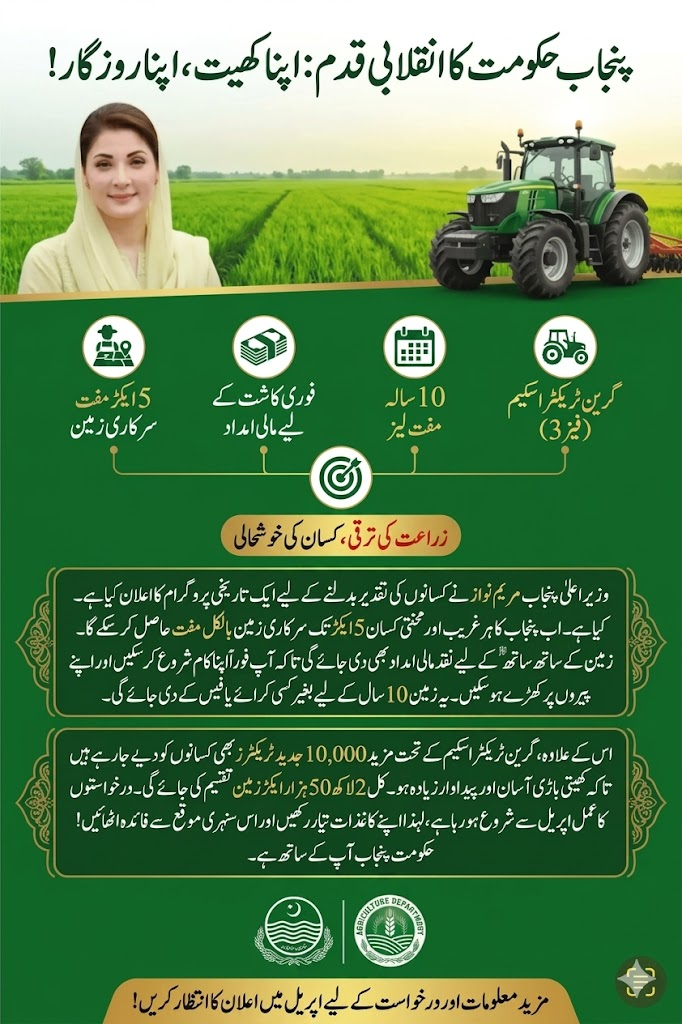
Announced officially on February 4, 2026, by Chief Minister Maryam Nawaz Sharif during an event in Rajanpur, the scheme commits the Punjab government to distributing 250,000 acres of state-owned agricultural land to deserving, landless citizens across all districts of Punjab. This is not a temporary relief package or a one-time subsidy. It is a structural transformation of how the state views its land assets, and who deserves to benefit from them.
This comprehensive guide covers every critical aspect of the program — its origins, objectives, eligibility criteria, the step-by-step application process, the financial support ecosystem it comes with, the land distribution timeline, the monitoring mechanisms, and the broader economic vision it represents. Whether you are a landless farmer in rural Punjab, a young person looking to build a livelihood in agriculture, or a policy researcher studying rural development programs in South Asia, this guide will give you everything you need to understand one of the most consequential government initiatives launched in Pakistan in recent years.
Application Schedule 2026
| Activity | Start Date | End Date |
| Application Receiving | 02 May 2026 | 18 May 2026 |
| List Of Initial Applicants Display | 19 May 2026 | — |
| Scrutiny Of Tehsil Monitoring Committee | 20 May 2026 | 30 May 2026 |
| Appeal To District Collector | 01 June 2026 | 08 June 2026 |
| Decisions By The District Collectors | 09 June 2026 | 16 June 2026 |
| Final List Of Eligible Applicants | 19 June 2026 | — |
| Computerized Balloting | — | — |
| Payment Of Lease Money | — | — |
| Allotment | — | — |
| Possession Handover | — | — |
What Is the AKAR Scheme and Why Was It Launched?
Before exploring the operational details of this program, it is important to understand the structural problem it is trying to solve. Thousands of families in Punjab depend on agriculture but own no land, forcing them into labor on others’ farms or migration to cities. This program creates immediate livelihood opportunities by converting state land into productive family farms.
The land ownership crisis in rural Punjab is not a new phenomenon. For decades, agricultural land in the province has been heavily concentrated in the hands of large landlords and feudal families. Landless peasants — known locally as haris or muzaras — have worked these fields in exchange for a share of the harvest, but they have never built equity, never accessed institutional credit, and never been able to make long-term investments in soil health or irrigation infrastructure, because the land they worked was not theirs.
When you don’t own land, you have no collateral for loans. You can’t make long-term soil investments. You can’t benefit from land value appreciation. You’re stuck in a cycle where you work hard but never build wealth.
Unlike short-term subsidy programs, this initiative focuses on sustainable rural income generation, especially in districts where youth migration and underemployment are rising. The government recognized that giving people seeds or fertilizer subsidies without giving them land to grow on was like giving someone a paint brush without a canvas. The fundamental asset — land — had to be in the hands of the people who would work it.
Officially approved on January 23, 2026, this initiative represents one of the largest land redistribution efforts in recent Pakistani history. The broader ideological framework behind the scheme is captured in the phrase “Apni Zameen… Apni Mehnat, Apni Fasal… Apna Rozgar” — meaning “Our Land… Our Effort, Our Crop… Our Livelihood.”
Apna khet apna rozgar is not just a housing or welfare program. It is an agricultural empowerment initiative rooted in the belief that sustainable self-employment can be created by putting productive state assets to work for the people who need them most.
Online Application Process
- Visit the official website (akar.pulse.gop.pk)
- Register using CNIC and mobile number
- Complete the application form
- Upload required documents
- Submit farming plan
- Receive application tracking number
- Track status via SMS or portal
Official Launch: Key Milestones and Announcements
Understanding the timeline of the program helps applicants know exactly where things stand and what to expect going forward.
February 4, 2026 — Chief Minister Maryam Nawaz Sharif announces the scheme during the inauguration of an electric bus service in Rajanpur. The announcement immediately captures national attention due to the sheer scale of land involved.
January 23, 2026 — The Punjab cabinet officially approves the scheme, giving it legislative and administrative backing.
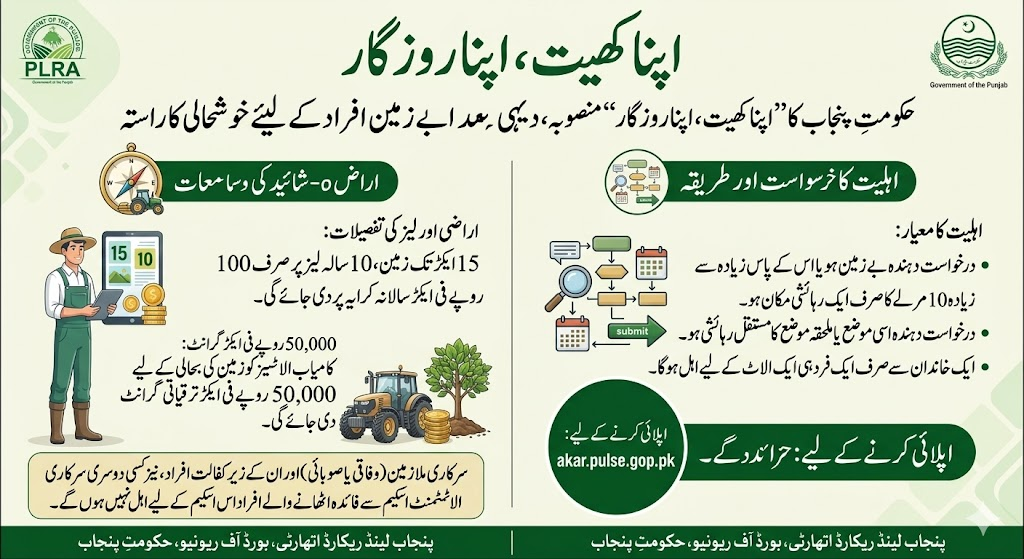
Late April 2026 — Punjab Chief Minister Maryam Nawaz Sharif formally inaugurated the portal “Apna Khet, Apna Rozgar Scheme,” aimed at boosting agricultural and economic prosperity in the province.
May 2 to May 18, 2026 — Applications open from May 2 to May 18, 2026, for the revolutionary scheme to provide FREE agricultural land to 50,000 landless farmers.
June 1 to June 8, 2026 — An appeals window is scheduled from June 1 to June 8 for applicants who wish to contest initial decisions.
June 19, 2026 — The final list of successful applicants will be issued on June 19, and land distribution is set to begin from June 30.
The speed of implementation reflects the seriousness with which the Punjab government has approached this initiative. The Chief Minister directed strict digital monitoring of the scheme and emphasized that complete information should be accessible to citizens at a single click.
-
How to Check Your Wasa bill Online: A Simple 2026 Guide
Managing utility bills has become much easier with digital services. Instead of visiting an office, waiting in long queues, or keeping paper copies for every month, consumers can now access their water and sanitation bills through online platforms. For residents who want a convenient way to review charges, confirm due dates, and avoid late payments,…
Scale and Scope: How Much Land Is Being Distributed?
The numbers associated with this program are genuinely historic. Understanding the scale helps contextualize why this is being called a landmark moment in Pakistan’s rural development policy.
Total Land: 250,000 acres of government-owned agricultural land across Punjab.
Agricultural Value: Agricultural land worth around 160 billion rupees will be provided to landless villagers.
Beneficiary Families (Punjab Districts): A total of 88,780 families will benefit from 13,812 agricultural plots across Punjab.
Beneficiary Families (Cholistan): 101,111 families will receive 16,685 plots in Cholistan.
Land per Applicant: Between 3 and 10 acres depending on availability and district allocation.
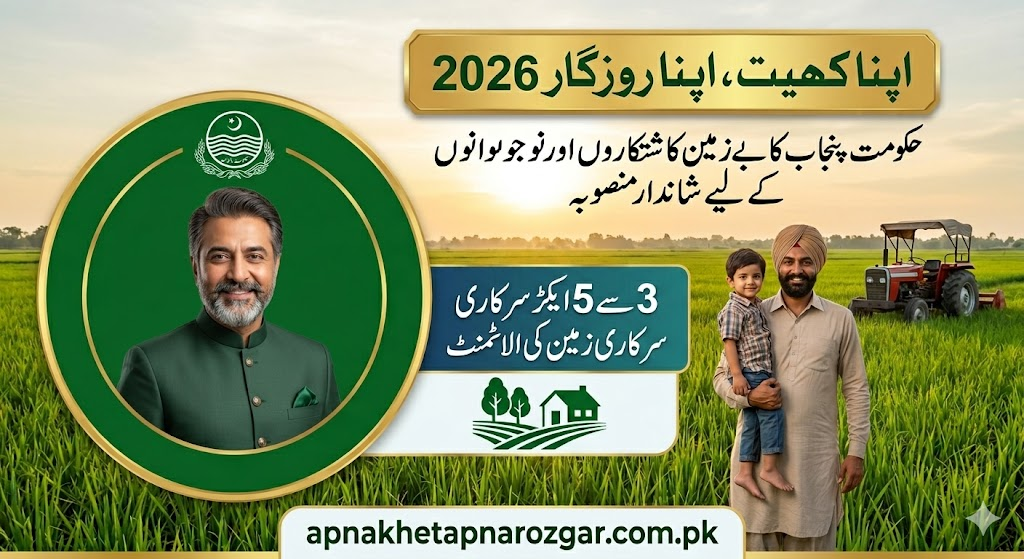
Land Value per Applicant: Each successful applicant will receive three to five acres of land worth Rs 2.5 million to Rs 4 million completely free of cost.
Development Grant: A one-time development grant ranging from Rs 50,000 to Rs 250,000 per acre will be provided to support land preparation.
Annual Lease Cost: The scheme offers landless Pakistani farmers 3-10 acres of government land on a 10-year lease at just Rs 100/acre annually.
The land is being selected based on a rigorous scientific process. Land selection will be based on key factors such as water availability and soil fertility to ensure viable cultivation. Authorities have identified 43,938 land units in districts and 83,425 in Cholistan, taking irrigation access and land quality into account.
This data-driven approach to land selection is significant. The government is not simply handing over barren desert to families and calling it redistribution. The land being allocated has been specifically identified as agriculturally viable, with irrigation access and fertile soil, so that beneficiaries have a realistic chance of succeeding.
Quick Information: Apna Khet Apna Rozgar at a Glance
| Detail | Information |
| Scheme Name | Apna Khet, Apna Rozgar (اپنا کھیت، اپنا روزگار) |
| Launched By | CM Maryam Nawaz Sharif, Punjab Government |
| Managing Authority | Punjab Land Records Authority (PLRA) |
| Land Lease Period | 10 years (extendable) |
| Lease Rate | Only Rs 100/acre per year |
| Total Beneficiaries | 50,000 families |
| Land Per Family | 3 to 10 acres (based on availability) |
| Target Applicants | Landless farmers, rural youth, marginalized groups |
| Official Portal | https://akar.pulse.gop.pk/ |
| Helpline | 042-111-111-111 |
| Support Email | support@akar.punjab.gov.pk |
| Application Status | Currently OPEN |
Who Can Apply: Eligibility Criteria in Detail
One of the most important questions any prospective applicant needs to answer is whether they qualify. The eligibility rules for apna khet apna rozgar have been designed to be inclusive enough to benefit genuinely deserving people while strict enough to prevent misuse or abuse of the program.
Basic Eligibility Requirements
The following criteria apply to all applicants:
Citizenship and Domicile: Applicant must be a Pakistani citizen with a valid CNIC. Must have a Punjab domicile and be a permanent resident of Punjab.
Age Limit: Between 18 and 35 years (extended up to 55 years for certain categories). Younger applicants aged 18 to 35 receive higher priority, reflecting the government’s focus on youth empowerment.
Land Status: Eligible applicants must be landless or own maximum 10 marlas residential property, be permanent residents of the revenue estate, and have no prior government allotments.
Credit History: Applicant should not be a defaulter of any bank or government loan.
Agricultural Background: Basic interest or background in agriculture is required.
Gender: Both men and women are eligible to apply. This is an important provision that makes the scheme genuinely gender-inclusive. Women, including widows and divorced women, are explicitly encouraged to apply.
Family Quota: Only one person per household is eligible. This prevents single families from claiming multiple plots.
Categories of Priority
Not all eligible applicants have equal priority. The selection process gives preference to:
- Completely landless individuals who own no agricultural land whatsoever
- Young people between 18 and 35 years of age
- Low-income families with documented financial hardship
- Widows, divorced women, and other vulnerable demographic groups
- Permanent residents of the specific revenue estate where the land is located
Small farmers who own up to 12.5 acres of existing land may also apply, but landless individuals can apply for leased land, while the landowners having agriland less than 12.5 acres may also apply but it will be subject to availability after the allotment to landless individuals.
Who Cannot Apply
The scheme is strictly reserved for genuinely deserving individuals. The following categories are explicitly excluded:
- Those who have previously benefited from any government land allotment or leasing program are ineligible.
- Employees of federal or provincial government departments, autonomous organizations, or corporations, along with their dependents, cannot apply.
- Individuals who are existing loan defaulters of any bank or financial institution.
- Those who own large agricultural landholdings beyond the permissible limit.
- Anyone with a criminal record.
These exclusions are important because they ensure that the program reaches the people it was designed for — landless laborers and unemployed rural youth — rather than being captured by government employees or those who already have access to land and credit.
Documents Required for Application
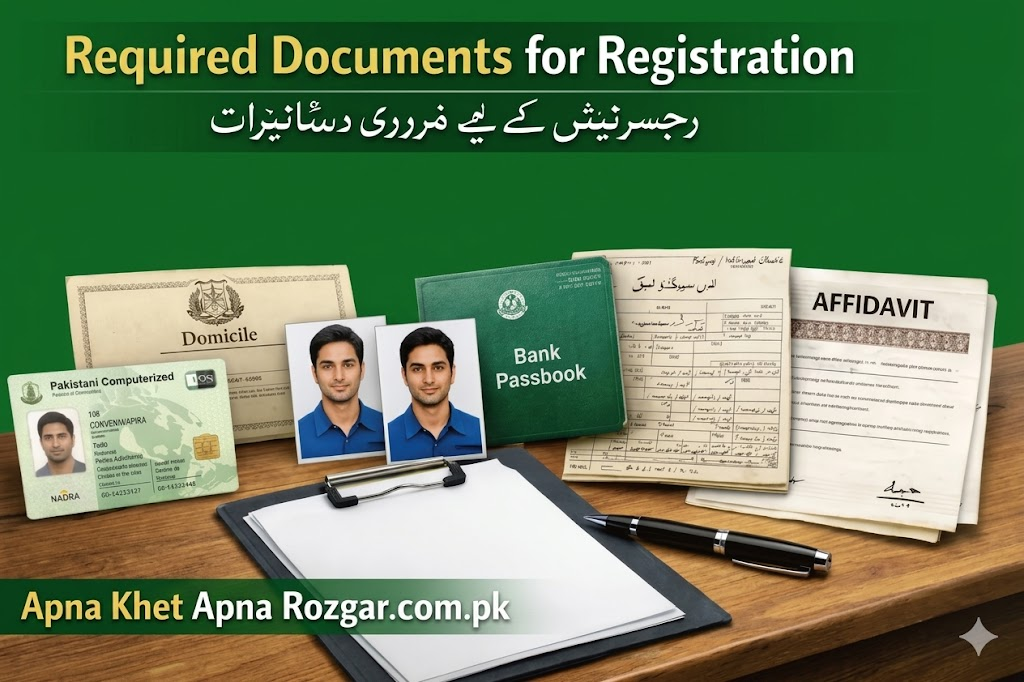
Preparing your documents in advance is one of the best ways to ensure a smooth and successful application. The following documents are typically required for the apna khet apna rozgar application process:
| Document | Purpose |
|---|---|
| Valid CNIC (National Identity Card) | Proof of identity and citizenship |
| Punjab Domicile Certificate | Proof of provincial residency |
| Proof of Landless Status | Revenue department certificate confirming no agricultural land |
| Income Certificate | Proof of low-income status |
| Unemployment Affidavit | Declaration of current unemployment |
| Skill or Agricultural Experience Certificate | Evidence of farming background (if available) |
| Utility Bill or Proof of Residence | Confirmation of address within revenue estate |
| Mobile Number (Active) | Required for OTP verification during registration |
| Bank Account Details | For receiving grants and financial support |
Valid CNIC, Punjab domicile, proof of land (if applicable), and any documents showing agricultural background or income status are required. Yes, both men and women can apply, including widows, divorced women, or disadvantaged applicants.
It is strongly advisable to obtain certified copies of all documents before beginning the online application process. Scanned copies of originals should be clear, legible, and properly formatted for digital upload.
How to Apply Online: Step-by-Step Registration Process
The government has built a fully digital application system to make apna khet apna rozgar accessible to as many people as possible across the province. The official portal is located at akar.pulse.gop.pk, which is the Punjab Land Records Authority’s digital gateway for this initiative.
Here is the complete step-by-step process for submitting your online application:
Step 1 — Visit the Official Portal
Navigate to the official government website for the scheme. Ensure you are on the correct government domain and not a third-party or fraudulent website. Look for the official government logo and verify the web address carefully before entering any personal information.
Step 2 — Create Your Account
Enter your CNIC number and active mobile number to create your login account. You will receive a verification code on your phone via SMS. Enter this OTP code accurately to verify your mobile number and activate your account.
Step 3 — Complete Your Profile
Fill in all personal details accurately, your name, address, district, tehsil, family information, and farming background. Take your time during this step because inaccuracies in profile information are one of the most common reasons for application rejection.
Step 4 — Fill the Application Form
Enter all required details in the online form, including land status, income level, and employment situation. The form will ask you to provide information about:
- Your current residential address within Punjab
- Your landholding status (completely landless or small landholder)
- Your household income and financial situation
- Your farming experience and agricultural background
- Your preferred district or region for land allocation
Step 5 — Upload Required Documents
Attach scanned copies of all required documents as listed above. Ensure that:
- Files are in the accepted format (typically PDF or JPEG)
- File sizes are within the specified limits
- Documents are clear, legible, and up to date
Step 6 — Review and Submit
Before hitting the submit button, thoroughly review every field of your application form. Check that:
- Your CNIC number is entered correctly
- Your name matches exactly with your CNIC
- Your contact information is accurate
- All uploaded documents are attached and visible
Step 7 — Track Your Application
The website allows applicants to submit forms, check eligibility criteria, track application status, and access important updates regarding agricultural loans and support.
All communication regarding selection happens through SMS to the registered mobile number. Applicants receive SMS alerts at every stage, including application receipt, verification scheduling, selection confirmation, and allotment ceremony invitations.
Offline Application Option
Recognizing that not all residents of rural Punjab have reliable internet access, the government has also made provisions for offline applications. Applications can be submitted online via the Punjab Enterprise Land Record Authority (PELRA) portal or manually at the Assistant Commissioner’s office once the official schedule is released.
Is There a Fee to Apply?
There is absolutely no registration fee for the scheme. The application process is completely free. Any individual or agent demanding money for registration or guaranteed selection is attempting fraud and should be reported to authorities.
The Complete Benefits Package: What Do Beneficiaries Actually Receive?
One of the things that makes this program genuinely revolutionary compared to previous agricultural initiatives is the comprehensive support ecosystem that surrounds the land allocation itself. Getting land is just the beginning.
Free Agricultural Land
The most fundamental benefit is, of course, the land itself. Each selected beneficiary receives 3-10 acres of government land on a 10-year lease at just Rs 100/acre annually. This is effectively free land — the Rs 100 annual lease rate is entirely nominal.
The land is described as a “long-term conditional allotment.” This means:
- The government retains formal ownership of the land
- The beneficiary receives full cultivation rights
- The beneficiary can grow any crop they choose
- The beneficiary owns all harvests produced
- The land cannot be sold, transferred, mortgaged, or used for non-agricultural purposes
- Sub-leasing to third parties is strictly prohibited
The allocated land cannot be sold, transferred, or mortgaged by the beneficiary. The government retains ownership, and cultivation rights are granted specifically to the selected individual. Any attempt to transfer rights results in immediate cancellation of the allotment.
Development Grant
In addition to the land itself, eligible beneficiaries receive agricultural plots valued between Rs2.5 million to Rs4 million on a 10-year lease, accompanied by one-time development grants ranging from Rs50,000 to Rs250,000 per acre to support initial cultivation costs.
This development grant is designed to help new farmers cover the costs of land preparation, which can include leveling, irrigation work, fencing, and initial soil treatment. Without this upfront support, even farmers who receive land might struggle to begin cultivation in the first season.
Kisan Card Integration
The Kisan Card isn’t just a plastic card — it’s a financial lifeline for successful farming:
- Direct access to agricultural credit without middlemen or commission agents
- Seasonal credit facility for purchasing seeds, fertilizers, and pesticides
- Government-backed subsidies credited directly to your account
- No interest charges on crop inputs purchased through the card
- Emergency support during natural disasters like floods or droughts
Over 400,000 farmers across Punjab are already using Kisan Cards, receiving subsidies worth billions of rupees directly without corruption or delays. Farmers report saving 30-40% on input costs.
For new beneficiaries of apna khet apna rozgar, automatic integration with the Kisan Card system means they can immediately access this existing subsidy infrastructure without navigating additional bureaucratic processes.
Green Tractor Scheme
Modern farming is impossible without mechanized equipment. Plowing, planting, irrigating, and harvesting even a five-acre plot manually is exhausting, inefficient, and ultimately economically unviable. The Punjab government has addressed this through the Green Tractor Scheme.
The Green Tractor Scheme connected with the program provides: Tractor Subsidy: Up to Rs 1,000,000 subsidy on new tractors (50-65 HP models); Zero Interest: Completely interest-free financing for land allottees; Equipment Support: Subsidies for laser land levelers, seeders, and harvesting equipment; Repayment Terms: Flexible payment schedules aligned with harvest seasons; Shared Machinery: Access to government-owned machinery for those who don’t need individual tractors.
Thousands of young farmers have purchased tractors through subsidized financing, reducing their cultivation costs by 50% and increasing yields by 25-30% through timely operations.
Interest-Free Agricultural Loans
Interest-free loans are available to selected beneficiaries for purchasing agricultural machinery and inputs. These loans carry no markup and are repayable in easy installments after harvest seasons. Qualified beneficiaries can access interest-free loans of specific amounts based on their land allocation and proposed crop plans. The loan amounts are calculated to cover essential machinery needs and input costs for the first growing seasons.
This provision is critical because it breaks one of the most common poverty traps facing landless farmers: the inability to access formal credit. Without land to offer as collateral, landless laborers have historically been forced to borrow from informal moneylenders at exploitative interest rates. This scheme eliminates that dependency entirely.
Agricultural Training and Technical Support
Land without knowledge produces nothing. That’s why the scheme includes comprehensive training: Free enrollment in modern farming technique workshops; Water-efficient irrigation methods and drip technology training; Crop rotation planning for soil health and maximum yield.
Government-run agricultural training centers have helped farmers adopt tunnel farming, drip irrigation, and high-value crop cultivation, tripling their per-acre income in some cases.
The training component recognizes that many potential beneficiaries may have farming experience as laborers but lack the technical knowledge needed to maximize yields on their own land. By providing structured training in modern techniques, the government is investing in the long-term productivity of each plot.
Market Linkages
One of the most overlooked barriers to agricultural success for small farmers is access to markets. Without connections to buyers, farmers are forced to sell through intermediaries who extract large margins, significantly reducing the income that actually reaches the farmer. The scheme includes provisions for market linkage programs, helping new landowners connect directly with buyers, cooperatives, and government procurement channels.
Crop Insurance and Disaster Support
The government provides crop insurance options, emergency financial support through Kisan Card, and technical assistance for recovery. You won’t be left stranded after one bad season.
This is a critical safety net that distinguishes this scheme from previous programs. Agriculture is inherently risky — floods, droughts, pest infestations, and price volatility can all devastate a season’s harvest. Having crop insurance and emergency support means that a single bad year does not destroy a family’s entire livelihood.
The Selection Process: How Are Beneficiaries Chosen?
The question of how beneficiaries are selected is one of the most important aspects of any public scheme of this scale. Corruption and favoritism in government land allocation programs have historically undermined similar initiatives in Pakistan and across the developing world. The Punjab government has put considerable thought into making apna khet apna rozgar transparent and merit-based.
Application Review and Scrutiny
All applications will undergo scrutiny by a designated committee. This committee will verify the information provided in each application against government databases, revenue records, and other official sources.
Computerized Balloting
The program benefits 50,000 families through transparent computerized balloting. In cases where multiple applicants apply for the same plot, a computerized lottery system will be used to make the final selection. This approach removes human discretion from the allocation process, significantly reducing the scope for favoritism or corruption.
In cases where multiple applicants apply for the same plot, allocation will be carried out through a balloting process.
District Quota System
Land availability varies significantly across Punjab’s 36 districts, and the scheme operates within a district quota framework. District Quota Dependency: Selection depends on land availability within each district. This means that an applicant from a district with limited government land may face higher competition, even if they are equally deserving as someone from a district with more available plots.
Monitoring and Compliance Verification
Once land is allocated, the government has established a robust monitoring system to ensure that it is being used as intended. To ensure compliance and productivity, each plot will be monitored by an agriculture officer and an internee, while a committee comprising assistant commissioners and agriculture department officials will conduct biannual inspections.
This biannual inspection regime is significant. The land allotment is conditional — beneficiaries must actively cultivate the land and follow agricultural guidelines, or they risk losing their allocation. However, this is not punitive but supportive — the agriculture officer and internee assigned to each plot are also there to provide guidance and assistance to new farmers.
Regional Coverage: Districts and Areas Covered
The scheme covers all 36 districts of Punjab, with land identified both in regular agricultural districts and in the special Cholistan region. Here is an overview of how coverage is distributed:
Punjab Districts (General):
- 43,938 land units identified across various districts
- 13,812 agricultural plots for allocation
- Expected to benefit 88,780 families
- Priority based on landlessness and local residency
Cholistan Region (Special Allocation):
- 83,425 land units identified in Cholistan
- 16,685 plots for allocation
- Expected to benefit 101,111 families
- Specific provisions for residents of Cholistan and riverine areas
The Punjab cabinet has approved the launch of the scheme for residents of Cholistan and riverine areas under easy terms and conditions. The meeting was briefed that 30,000 plots had been identified for this programme, while nearly 200,000 families had already submitted applications for the initiative.
The inclusion of Cholistan is particularly significant. This vast desert region in southern Punjab has historically been one of the most economically marginalized areas in the province. The scheme’s reach into Cholistan reflects a commitment to ensuring that even the most remote and underserved communities benefit from land redistribution.
How This Scheme Is Different From Previous Programs
Pakistan has seen many government agricultural support schemes over the decades — from fertilizer subsidies to loan programs to tractor schemes. Why is this time different? What makes apna khet apna rozgar more likely to succeed than its predecessors?
It Addresses Root Causes, Not Symptoms
Previous schemes gave farmers tools to work land that wasn’t theirs. This scheme gives them the land itself. Think about what happens when a 25-year-old farmer receives 5 acres: Year 1: They learn modern techniques, invest with Kisan Card support, earn decent income. Year 3: They’ve built expertise, maybe diversified into high-value crops, income doubles.
It Combines Multiple Forms of Support
Rather than offering a single benefit — land, or loans, or machinery subsidies — this program bundles all of them together. Policy experts consider this program more sustainable than past subsidy schemes because it combines land ownership, financial access, and technical support under one model.
It Uses Digital Infrastructure for Transparency
The online registration simplifies applying for agricultural support by collecting personal, land, and income details digitally, enabling quick verification, tracking status updates, and ensuring transparent access to scheme benefits across Punjab. The fully digital application and monitoring system makes it significantly harder for bureaucratic corruption to intercept benefits before they reach the intended recipients.
It Creates Long-Term Assets, Not Short-Term Relief
Unlike cash transfer programs that provide temporary income support, land allocation creates a productive asset that generates income year after year. A family that receives five acres and cultivates it successfully can potentially pass that cultivation right to the next generation, creating intergenerational wealth in communities where no such wealth has existed before.
It Links Farming to Modern Market Systems
The integration with Kisan Card, Green Tractor Scheme, and agricultural training centers means beneficiaries are not just given land — they are plugged into a modern agricultural ecosystem that gives them a real chance of competing in today’s market.
Economic Impact: What This Means for Punjab and Pakistan
The potential economic impact of apna khet apna rozgar extends far beyond the direct benefits to 190,000 families. The broader ripple effects could be substantial.
Agricultural Productivity
By bringing currently underutilized government land into productive cultivation, the scheme will increase Punjab’s total agricultural output. More food produced domestically means lower food import bills, greater food security, and downward pressure on local food prices that benefit all consumers.
Rural Employment Creation
Each new farming operation creates not just income for the primary beneficiary but also employment opportunities for others. A five-acre farm requires additional labor during planting and harvest seasons, creates demand for local agricultural input suppliers, and generates economic activity in nearby rural markets.
Reduction of Rural-Urban Migration
One of the most pressing challenges facing Pakistan’s cities is unplanned urbanization driven by rural poverty. When young people see no economic future in their villages, they migrate to cities, creating pressure on urban housing, infrastructure, and labor markets. By creating viable rural livelihoods, this scheme could reduce that migration pressure significantly.
Women’s Economic Empowerment
The explicit inclusion of women, widows, and divorced women as eligible applicants means that the scheme could play a meaningful role in women’s economic empowerment in rural Punjab. Women who own cultivation rights have bargaining power within their households and communities that was previously unavailable to them.
Food Security
Increased cultivation will also boost food production, reduce market prices, and strengthen Pakistan’s agricultural economy. The government aims to create long-term prosperity by empowering farmers at the grassroots level.
Pakistan has faced recurring food security challenges, exacerbated by population growth, climate change, and underinvestment in agriculture. Bringing large tracts of fertile land into productive cultivation is a direct contribution to strengthening the country’s food security.
Frequently Asked Questions
What exactly is the scheme and how does it work?
It is a government initiative that distributes state-owned agricultural land to landless farmers and unemployed rural youth across Punjab. The program transfers cultivation rights of government land to individuals who possess farming skills but lack their own land to earn a livelihood.
How much land will I receive if selected?
Each selected beneficiary receives between 3 to 5 acres of agricultural land, depending on availability in their district. In some categories, up to 10 acres may be allocated depending on the zone and available stock.
Is the land given permanently or on a lease?
The land is provided on a long-term lease. The government retains ownership while beneficiaries receive cultivation rights. However, the government has indicated that conversion to permanent ownership may be considered based on sustained cultivation performance over time.
Can I sell or rent the land I receive?
No. The land will be provided for 10 years strictly for agricultural use, with no permanent construction allowed. Selling, renting, or sub-leasing the land will result in immediate cancellation of your allotment.
What happens if my crops fail due to weather or other disasters?
The government provides crop insurance options, emergency financial support through Kisan Card, and technical assistance for recovery.
Can I apply if I am a woman?
Yes. Women are explicitly eligible and encouraged to apply. Both men and women can apply, including widows, divorced women, or disadvantaged applicants.
Is there an application fee?
Zero-Cost Registration: Applying for the scheme is completely free, with both online and offline options available to ensure accessibility for all rural applicants.
What happens after I submit my application?
Your application will undergo scrutiny by a designated government committee. If selected in the balloting process, you will receive an SMS notification on your registered mobile number with further instructions. The entire process from application to land distribution is expected to take approximately six to eight weeks.
Can a government employee apply?
No. Government employees and their dependents are explicitly excluded from eligibility. The scheme is designed specifically for unemployed rural citizens and landless farmers.
What is the Kisan Card and how do I get one?
The Kisan Card is a government-issued agricultural credit card linked to subsidized inputs and government support programs. The government provides initial support packages including seeds and fertilizers for the first cropping season through the Kisan Card system. This ensures new farmers can begin cultivation immediately without arranging capital for basic inputs. Beneficiaries of the land scheme are integrated into the Kisan Card system as part of their onboarding process.
What if I live abroad but have Punjab domicile?
Technically, you can apply online, but you must be present in Pakistan for verification, land transfer, and cultivation. The scheme is designed for those who will personally farm the land, not absentee owners.
How competitive is the application process?
Limited Seats: Only around 50,000 families may benefit initially, making competition high. Given that nearly 200,000 families had already submitted applications early in the process, the competition is expected to be significant. This makes it especially important to ensure your application is complete, accurate, and well-documented.
What agricultural projects can I pursue with the allocated land?
The scheme supports a wide range of agricultural projects, including: Starting a dairy farm with cows or buffaloes; Setting up poultry units for egg or meat production; Growing seasonal crops and vegetables; Small-scale businesses related to agriculture.
What is the helpline number for the scheme?
Helpline: 042-111-111-111. Applications are currently open statewide.
How will the balloting process work?
The selection uses computerized balloting to ensure transparency and fairness. Once all applications have been submitted and verified, a computerized lottery system will randomly assign plots to eligible applicants in cases where multiple people have applied for the same land.
Tips for a Successful Application
Given the competitive nature of the application process, here are evidence-based tips to maximize your chances of a successful outcome:
Prepare Documents in Advance: Before beginning your online registration, gather all required documents in their original form and create clear digital copies. Missing documents are one of the most common reasons applications are rejected or delayed.
Be Completely Accurate: Provide only truthful information. The government will verify your claims against revenue records, NADRA databases, and other official sources. Any discrepancy discovered during verification can result in immediate disqualification.
Apply Within the Window: The application window runs from May 2 to May 18, 2026. Applications submitted after this deadline will not be considered. Do not wait until the last day.
Demonstrate Agricultural Knowledge: The application form may ask about your farming background. Even if you have not owned land, your experience as a farmworker, knowledge of crops, or participation in community agricultural activities is worth documenting clearly.
Use the Official Portal Only: Scammers and fraudsters have created fake websites that mimic the official portal. Always verify that you are using akar.pulse.gop.pk and no other website before entering personal information.
Keep Your Mobile Active: All communication about your application status, including verification requests and selection notifications, will be sent via SMS to your registered mobile number. Ensure this number remains active throughout the process.
Document Your Landlessness Clearly: Since landless applicants receive the highest priority, making sure your landless status is clearly documented with a certificate from the revenue department will significantly strengthen your application.
Avoid Middlemen: Any individual or agent demanding money for registration or guaranteed selection is attempting fraud and should be reported to authorities.
Common Mistakes That Lead to Rejection
Many applicants make avoidable errors that result in their applications being rejected. Being aware of these pitfalls can save you significant time and frustration.
- Providing incorrect or mismatched CNIC numbers
- Submitting documents with expired validity dates
- Uploading blurry or illegible document scans
- Failing to declare existing landholdings honestly
- Applying through unofficial third-party websites
- Missing the application deadline
- Using an incorrect or inactive mobile number
- Applying on behalf of a family member who has already applied (only one application per household)
Challenges and Limitations to Be Aware Of
Acknowledging the limitations of the scheme honestly is important for managing expectations.
Limited Seats: Only around 50,000 families may benefit initially, making competition high. Strict Eligibility Rules: Applicants must meet domicile, land status, and financial history requirements. District Quota Dependency: Selection depends on land availability within each district. Processing Time: Verification and approval may take several weeks. Conditional Allotment: Land must be used strictly for farming and cannot be sold or rented.
Additionally, the long-term success of the scheme will depend heavily on continued government support for the ecosystems that make farming viable — irrigation infrastructure, roads connecting farms to markets, price support programs, and ongoing agricultural extension services. The land allocation is the most visible intervention, but sustaining its impact requires sustained commitment from the government across multiple departments and budget cycles.
The Cholistan region presents specific challenges. Desert land requires significant water management infrastructure, and many plots in Cholistan will need investment in irrigation before they can be reliably productive. The development grants provided are intended to cover some of these costs, but the scale of investment needed in Cholistan’s agricultural infrastructure should not be underestimated.
The Broader Vision: From Land Reform to Rural Transformation
To truly appreciate the significance of apna khet apna rozgar, it must be placed within the broader arc of Pakistan’s rural development challenges. Pakistan is a country where roughly 38% of the population is directly employed in agriculture, yet agricultural productivity per worker remains significantly below the potential suggested by the country’s land and water resources.
The gap between potential and actual agricultural output is largely explained by structural issues: small and fragmented landholdings, lack of access to credit, outdated farming techniques, inadequate irrigation infrastructure, and poor market connectivity. This scheme directly addresses several of these issues simultaneously.
By linking land access with training and guided financing, the government aims to strengthen food security, local economies, and long-term rural stability. For many young Pakistanis, agriculture is no longer just inheritance — it is becoming an entrepreneurial opportunity.
This is perhaps the most hopeful dimension of the initiative. If it succeeds in changing how young Pakistanis perceive agricultural employment — from a last resort of the uneducated poor to a viable, dignified, and entrepreneurially rewarding career path — it could have generational effects on both rural economic development and national food security.
If implemented transparently and efficiently, this initiative could redefine how rural youth engage with farming — turning idle potential into measurable economic growth across the province.
The government’s emphasis on digital transparency, computerized balloting, and regular monitoring reflects a recognition that good intentions are not enough. Programs of this scale succeed or fail based on their implementation quality. The establishment of a digital monitoring system, the assignment of agriculture officers to individual plots, and the biannual inspection regime all reflect a serious approach to accountability.
Comparison With Similar Programs in Pakistan and Beyond
Punjab Rozgar Scheme: Provides subsidized small business loans through PSIC and Bank of Punjab, but does not involve land allocation. It targets non-agricultural self-employment.
Apni Chhat Apna Ghar: A housing-focused initiative providing interest-free loans for home construction — complementary but distinct from the agricultural focus of apna khet apna rozgar.
Mera Pakistan Mera Ghar: A national-level low-cost housing finance scheme managed through the State Bank of Pakistan, again complementary but not agricultural in focus.
Green Tractor Scheme: This machinery subsidy program is now integrated directly into the land allocation scheme, rather than operating independently, creating much greater impact per rupee of government investment.
Internationally, similar land redistribution programs have shown mixed results. Programs in Brazil, India, and South Africa provide instructive lessons. The most successful have combined land allocation with comprehensive support services — exactly the model that Punjab’s program is attempting. Programs that simply allocated land without supporting infrastructure, training, and market access frequently failed because beneficiaries lacked the capital and knowledge to make their plots productive.
Frequently Asked Questions About the Application Portal
Is the akar.pulse.gop.pk portal secure?
Yes. The portal operates on official Punjab government servers with standard digital security protocols. You should only enter your information on this official portal and not share your CNIC or personal details with third-party websites.
What if I face technical problems during the application process?
Contact the official helpline at 042-111-111-111 for technical support. You may also visit your nearest District Agriculture Office for in-person assistance.
Can I apply from a mobile phone?
Yes. The portal is designed to be mobile-friendly and accessible from smartphones. This is particularly important given that internet access in rural Punjab is predominantly via mobile devices rather than computers.
What format should my uploaded documents be in?
Documents should typically be uploaded as clear JPEG or PDF files. Ensure that each document is legible and that the file size is within the limits specified on the portal.
Can I update my application after submission?
The portal may allow you to update certain fields before the application deadline. After the deadline, submissions are generally locked for review. It is therefore important to double-check all information before final submission.
Conclusion: A Historic Opportunity That Deserves Serious Attention
The launch of apna khet apna rozgar represents more than a government scheme — it represents a fundamental shift in how the state of Punjab thinks about the relationship between its citizens and the land resources that belong to them collectively. For the first time in Pakistan’s recent history, a provincial government is committing at scale to the idea that state-owned agricultural land should be actively productive, and that the people best positioned to make it productive are the rural poor who have spent their lives working on land that was never theirs.
The numbers are impressive: 250,000 acres, 190,000 families, Rs 160 billion worth of land, development grants of up to Rs 250,000 per acre, integration with Kisan Card and Green Tractor Scheme, free technical training, biannual monitoring. But what matters most is not the numbers — it is whether these resources actually reach the people they are intended for and whether the support ecosystem around land allocation is robust enough to help new farmers succeed in the long term.
The program represents a transformative step toward rural empowerment, agricultural revival, and economic stability in Punjab.
For eligible applicants, the message is clear: this is a rare and significant opportunity. The application window is limited. The competition will be substantial. But for those who meet the criteria, prepare their documents carefully, submit an accurate and complete application, and are willing to commit to the hard work of farming, apna khet apna rozgar could genuinely be life-changing — not just for the primary beneficiary, but for their entire family and, through the multiplier effects of agricultural employment and food production, for their communities as well.
Pakistan’s rural poor have waited a long time for a program of this scale and ambition. Whether that wait was worth it will depend on the integrity and competence of implementation. The framework is promising. The resources are committed. The land is ready. Now it is up to the government to deliver and up to deserving citizens to step forward and claim an opportunity that was a long time coming.