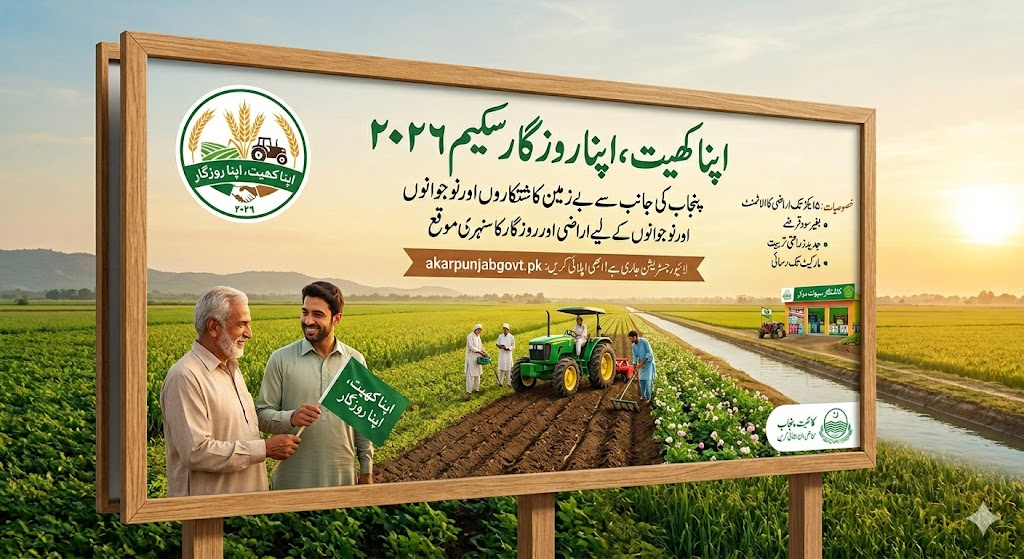
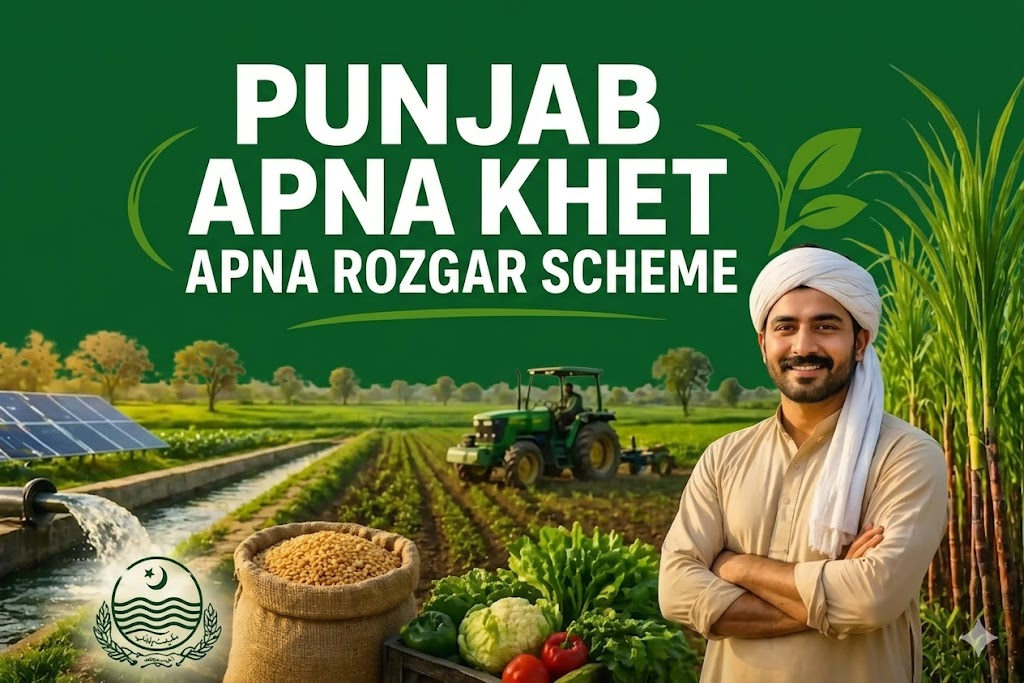
The apna khet apna rozgar scheme 2026 is one of the most ambitious, wide-reaching, and transformative agricultural land distribution programs that the Government of Punjab has ever launched in Pakistan’s modern history. Unveiled under the visionary leadership of Chief Minister Maryam Nawaz Sharif, this landmark initiative is poised to reshape the lives of hundreds of thousands of landless rural families across all 36 districts of Punjab, giving them not just land to cultivate but a comprehensive system of support, training, and financial assistance to build a genuinely sustainable future. uploadblog, durostech lcfmodgeeks, aliensync, befitnatic, mygreenbucks
For decades, rural Punjab has been locked in a cycle of poverty driven by a single fundamental problem: landlessness. Farmers who work the soil every single day of their lives own none of it. They labor on land belonging to feudal landlords, pay heavy rents, and when the crop season ends, they are left with barely enough to survive. Children in these families grow up without educational opportunities. Women in these households carry the double burden of unpaid domestic labor and farm work without any share in the household assets. Youth who want to build a future through agriculture have no starting point. This is the structural injustice that the apna khet apna rozgar scheme 2026 is designed to directly address and dismantle.
The program’s full name — “Apni Zameen… Apni Mehnat, Apni Fasal… Apna Rozgar” (Own Land, Own Effort, Own Crop, Own Livelihood) — captures its philosophy perfectly. It is not simply a subsidy or a cash transfer. It is a pathway toward genuine economic independence, grounded in the oldest and most reliable form of wealth creation that this land has ever known: agriculture.
What Is the AKAR Scheme and Why Does It Matter?
The Apna Khet Apna Rozgar Scheme, also known as AKAR Scheme, is a provincial-level agricultural land distribution program officially approved on January 23, 2026. It represents one of the largest land redistribution efforts in recent Pakistani history, designed to address rural unemployment and landlessness in Punjab.
Punjab’s rural communities have long struggled with a single deep-rooted problem. They work the land but they do not own it. Rising inflation, expensive farming inputs, and a lack of resources have pushed thousands of landless families deeper into poverty with every passing year.
To understand why the apna khet apna rozgar scheme 2026 matters so deeply, you need to understand the scale of the crisis it is trying to solve. Punjab is Pakistan’s most populous and agriculturally productive province. It feeds the country. Its wheat, rice, sugarcane, and cotton output sustains Pakistan’s food security. Yet the very people who plant and harvest these crops — the actual tillers of the earth — own almost nothing. The feudal land ownership structure that was entrenched during the colonial era has never been fully dismantled. Land reform attempts in the past have either been partial or have been reversed over time under political pressure from landowning elites.
What makes the apna khet apna rozgar scheme 2026 different from previous initiatives is not just its scale — though the scale is enormous — but its approach. Rather than attempting the politically explosive step of redistributing privately owned land, this scheme focuses on state-owned and government-held agricultural land that is currently lying unused, unproductive, and benefiting no one. Under this scheme, agricultural land worth approximately Rs 160 billion will be distributed among landless rural residents, with the aim of promoting agricultural productivity and economic prosperity across Punjab.
This is smart policy. The government is not taking land from anyone. It is converting barren, unproductive government land into cultivable plots and handing them to the people best suited to make them productive: landless farmers who have the skills, the motivation, and the local knowledge to turn these plots into thriving agricultural operations.
The program covers all 36 districts of Punjab, with 13,812 agricultural plots identified across various districts and an additional 16,685 plots in the Cholistan region. In total, this means hundreds of thousands of acres being brought into productive use, and hundreds of thousands of families being given the opportunity to break out of the poverty trap permanently.
The Scale and Reach of the Initiative
Numbers tell the story of scale, but behind every number is a family. Let’s look at what this program actually means in terms of reach:
A total of 88,780 families will benefit from 13,812 agricultural plots across Punjab, while 101,111 families will receive 16,685 plots in Cholistan. The land will be provided for 10 years strictly for agricultural use, with no permanent construction allowed.
That is nearly 190,000 families in the first phase alone. If you estimate an average of five members per family — a conservative estimate for rural Punjab — you are looking at nearly one million people whose lives will be directly impacted by the apna khet apna rozgar scheme 2026. The ripple effects extend far beyond the direct beneficiaries. When a family gains land, their spending power increases. Local markets benefit. Children can stay in school because the financial pressure on the family is reduced. Women gain security. The whole community sees an increase in economic activity.
This flagship program aims to distribute over 124,000 acres of government-owned agricultural land worth approximately Rs 160 billion to more than 88,000 deserving families, creating sustainable self-employment opportunities through farming. Under this transformative scheme, eligible beneficiaries receive agricultural plots valued between Rs 2.5 million to Rs 4 million on a 10-year lease, accompanied by one-time development grants ranging from Rs 50,000 to Rs 250,000 per acre to support initial cultivation costs.
The inclusion of Cholistan is particularly significant. Cholistan is a vast semi-arid region in southern Punjab that has historically been underutilized due to water scarcity and lack of infrastructure. According to official data, the identified land is being divided into mouza-wise agricultural lots of up to five acres, each approved by district collectors. The initiative relies on GIS-based land mapping and digital systems to identify, allocate, and monitor agricultural land across districts and parts of the Cholistan region.
The use of Geographic Information Systems (GIS) technology to map land availability, water access, and soil fertility reflects a modern, data-driven approach that previous government schemes rarely employed. Agricultural land will be selected based on irrigation availability and soil quality, ensuring that the plots allocated to beneficiaries are actually capable of being farmed successfully.
Core Features and Benefits of the Program
The apna khet apna rozgar scheme 2026 is not a single-benefit program. It is a comprehensive support ecosystem. Understanding all its components is essential for appreciating why experts have called it a potential game-changer for rural Punjab.
Agricultural Land Allocation
The scheme’s key features include free land allocation of 3 to 10 acres on a 10-year lease, with a lease cost of only Rs 100 per acre per year — almost free. To put this in perspective, market lease rates are around Rs 150,000 per acre, meaning that beneficiaries are receiving land at approximately 0.067% of its commercial lease value. This is not a subsidy — it is a transformational opportunity.
The land is allotted on a conditional basis. Agricultural land will be identified based on water availability and soil fertility, and each successful applicant will receive agricultural land worth Rs 2.5 million to Rs 4 million for cultivation. Additionally, a one-time development grant ranging from Rs 50,000 to Rs 250,000 per acre will be provided to support land preparation.
This one-time development grant is critical. New farmers arriving on previously unfarmed government land need to level the ground, establish irrigation channels, purchase initial inputs like seeds and fertilizers, and perhaps set up basic storage structures. The development grant makes this possible without the beneficiary needing to take on debt from the very first day.
Integration with the Green Tractor Scheme
Modern farming requires modern machinery. Hand labor alone cannot make large-scale agriculture viable or profitable. The Green Tractor Scheme connected with Apna Khet Apna Rozgar provides a tractor subsidy of up to Rs 1,000,000 on new tractors (50–65 HP models), completely interest-free financing for land allottees, equipment support through subsidies for laser land levelers, seeders, and harvesting equipment, flexible payment schedules aligned with harvest seasons, and access to government-owned machinery for those who don’t need individual tractors.
The inclusion of laser land levelers deserves special attention. A laser land leveler uses GPS-guided technology to perfectly flatten agricultural land, dramatically improving water distribution during irrigation. Studies show that properly leveled land can reduce water use by up to 30% while simultaneously increasing crop yields by 10–15%. For farmers in water-scarce areas of Punjab and Cholistan, this technology could be the difference between a successful harvest and crop failure.
The Kisan Card Facility
The Kisan Card provides direct access to agricultural credit without middlemen or commission agents, a seasonal credit facility for purchasing seeds, fertilizers, and pesticides, government-backed subsidies credited directly to the farmer’s account, no interest charges on crop inputs purchased through the card, and emergency support during natural disasters like floods or droughts.
The Kisan Card addresses one of the most persistent problems in Pakistan’s agricultural sector: the role of the middle man. Traditionally, farmers who needed to purchase inputs on credit were forced to borrow from local commission agents who charged exploitative interest rates. These agents then demanded the right to purchase the farmer’s crop at artificially low prices, keeping the farmer permanently in debt and permanently poor. The Kisan Card system cuts out this exploitative middleman entirely.
Over 400,000 farmers across Punjab are already using Kisan Cards, receiving subsidies worth billions of rupees directly without corruption or delays. Farmers report saving 30–40% on input costs.
Professional Agricultural Training
Land and tools are not enough on their own. Farming is a knowledge-intensive activity, and modern farming even more so. The scheme includes comprehensive training that covers free enrollment in modern farming technique workshops, water-efficient irrigation methods and drip technology training, and crop rotation planning for soil health and maximum yield.
The training programs include instruction in tunnel farming — a technique that allows year-round cultivation of vegetables and fruits regardless of the season, dramatically increasing per-acre income. Drip irrigation training is particularly valuable for Cholistan farmers where water availability is limited. Crop rotation planning teaches farmers how to alternate crops in a way that naturally replenishes soil fertility, reducing the need for expensive synthetic fertilizers.
Market Linkage and Price Support
One of the most common failures in agricultural development programs globally is that farmers succeed at growing crops but fail at selling them at profitable prices. The apna khet apna rozgar scheme 2026 addresses this through market linkage support that connects beneficiary farmers directly with buyers, wholesalers, and food processing units, ensuring they receive fair prices for their produce rather than being forced to sell at distressed prices to local middlemen.
Biannual Government Supervision
Each plot will be supervised by an agriculture officer and an agricultural internee, while a committee comprising Assistant Commissioners and officials from the Agriculture Department will conduct biannual inspections to review cultivation activities.
This supervision structure ensures that land allottees are not left alone to figure things out. Government agriculture officers will visit plots twice a year, assess crop conditions, provide guidance on fertilizer application and pest management, and help farmers troubleshoot problems before they turn into catastrophic crop failures. This level of hands-on government support is rare in Pakistani agricultural policy and represents a genuinely innovative approach. apna khet apna rozgar scheme apply online
Who Can Apply? Comprehensive Eligibility Criteria
The apna khet apna rozgar scheme 2026 has been designed to ensure that its benefits reach the most deserving applicants. The eligibility criteria are specific and strictly enforced.
Primary Eligibility Requirements
| Requirement | Details |
|---|---|
| Citizenship | Must be a Pakistani citizen with a valid CNIC |
| Residency | Permanent resident of Punjab with valid domicile |
| Age Limit | 18 to 35 years (extended to 55 years for certain categories) |
| Land Status | Completely landless OR own maximum 10 marlas residential property |
| Credit History | Must not be a defaulter of any bank or financial institution |
| Prior Allotments | Must have received no prior government land allotments |
| Farming Background | Basic farming knowledge or agricultural experience preferred |
| Criminal Record | Must have no criminal convictions or pending serious charges |
To qualify for the scheme, applicants must be permanent residents of Punjab with valid CNIC or domicile, be between 18 and 35 years of age (extended up to 55 years for certain categories), be completely landless or own very small agricultural land, must not be a defaulter of any bank or financial institution, and should demonstrate basic farming experience or agricultural background.
Eligible applicants must be landless or own maximum 10 marlas residential property, be permanent residents of the revenue estate, and have no prior government allotments.

Who Is NOT Eligible?
Applicants who own large agricultural land holdings, have criminal records, or are existing loan defaulters are not eligible for this scheme. Additionally, applicants must be willing and able to cultivate the allotted land personally — sub-leasing or commercial transfer is strictly prohibited.
This last point is important and reflects the government’s determination to prevent the scheme from being captured by large landowners or speculators. The land must be personally cultivated. It cannot be rented out to someone else. If an allottee fails to cultivate the land or is found to have sub-leased it, the allotment will be cancelled and the plot will be reallocated to the next eligible applicant on the waiting list.
Special Categories Receiving Priority
The apna khet apna rozgar scheme 2026 includes special provisions for vulnerable groups. Women — particularly widows, single mothers, and women who are the primary breadwinners in their households — are encouraged to apply and receive favorable consideration during the selection process. This is a progressive step in a province where women’s access to land ownership has historically been extremely limited.
Applicants from already marginalized communities, those with demonstrable farming experience even in the absence of land, and residents of particularly poor revenue estates also receive priority consideration.
Required Documents Checklist
Preparing the correct documents is one of the most important steps in the application process. Missing or incorrect documentation is one of the most common reasons for application rejection. The following documents are required:
Identity Documents:
- Original and photocopy of Computerized National Identity Card (CNIC)
- CNIC must be valid and not expired at the time of application
- Applicants who are women should also provide their husband’s or father’s CNIC
Proof of Residence:
- Punjab domicile certificate
- B-Form or Fard (land record document) confirming landless status from the local Patwari
- Utility bill (electricity/gas) in the applicant’s name confirming current address
Financial Documents:
- Bank statement or declaration of no bank loan defaults
- BISP or socio-economic survey record (if applicable and available)
- Proof of income or lack thereof (income certificate from Union Council)
Supplementary Documents:
- Active Pakistani mobile phone number registered in the applicant’s own name
- Passport-sized photographs
- Any document proving agricultural background or experience
- For women applicants: Marriage certificate or proof of widowhood if applicable
Important Notes on Document Preparation: All documents must be original or officially attested photocopies. Scanned versions uploaded to the online portal must be clear, fully legible, and in their entirety. Blurry or partial scans are among the top reasons for rejection. All information across documents must be consistent — any discrepancy between CNIC details and the application form will trigger automatic disqualification.
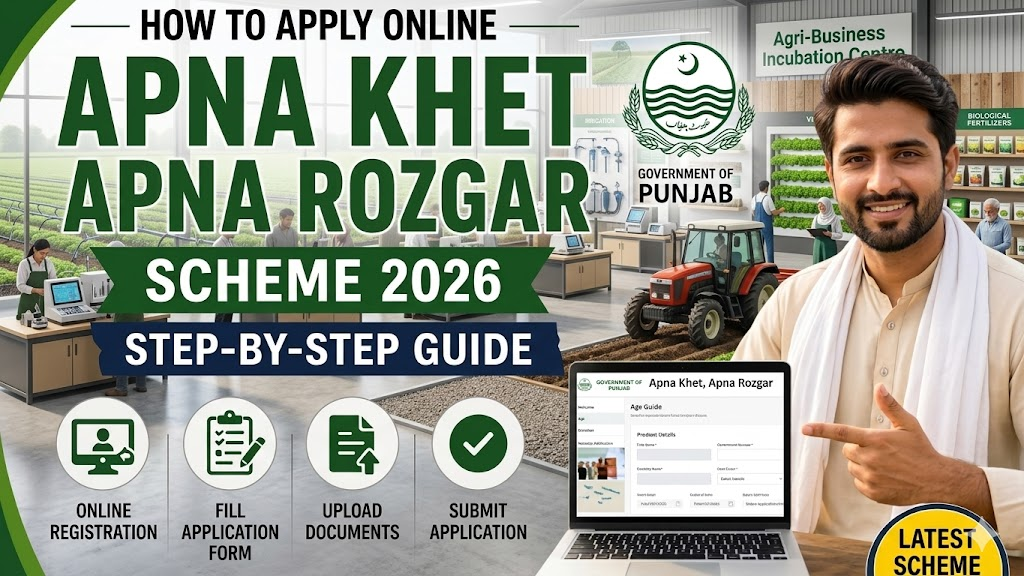
Step-by-Step Online Application Process
The Punjab government has invested significantly in building a user-friendly digital registration system for the apna khet apna rozgar scheme 2026. The online portal is designed to be accessible even to applicants with limited digital literacy.
Step 1: Access the Official Portal
Visit the official registration portal maintained by the Punjab government. The main registration platforms are akar.pulse.gop.pk and agripunjab.gov.pk. Always verify that you are on a genuine .gov.pk domain before entering any personal information. Fraudulent websites mimicking government portals exist — never provide your CNIC or personal data to an unofficial website.
Only apply through .gov.pk domains to avoid scams.
Step 2: Create Your Registration Account
Click on “New Registration” or “Register Here” on the portal’s homepage. Enter your CNIC number accurately — this number is the anchor identity for your entire application. Enter your active mobile phone number, which must be registered in your own name. Applicants whose mobile numbers are registered in other people’s names have faced verification problems, so ensure your SIM registration matches your CNIC.
Step 3: OTP Verification
After entering your CNIC and mobile number, you will receive a One-Time Password (OTP) via SMS on your registered mobile. Enter this OTP in the verification field on the portal. If the OTP is delayed, wait 2–3 minutes before requesting again. Do not request multiple OTPs in rapid succession, as this can lock your account temporarily.
Step 4: Complete Your Personal Profile
Once your account is verified, you will be directed to fill in your complete profile. This includes:
- Full name as appearing on CNIC
- Father’s or husband’s name
- Date of birth
- Permanent residential address in Punjab
- Revenue estate (mouza) of residence
- Union Council and Tehsil details
- District
Step 5: Submit Land Status Declaration
You will be required to declare your current land ownership status. This declaration is cross-referenced against land records held by the Punjab Land Records Authority (PLRA). Any false declaration of landlessness will result in permanent disqualification and may have legal consequences.
Step 6: Upload Required Documents
Scan or photograph all required documents clearly. Upload them in the designated fields. Ensure every document is:
- Clearly readable, with no blurring
- Complete — not cut off at edges
- In the correct file format (usually PDF or JPEG)
- Within the file size limits specified by the portal
Step 7: Choose Preferred District and Plot Area
The portal allows you to indicate your preferred district for land allotment. While final allotment is subject to availability and balloting results, indicating a preference ensures that your application is considered in the districts where you are best positioned to actually cultivate the land.
Step 8: Review and Submit
Before final submission, carefully review all information entered. Incorrect CNIC details or blurry documents are the number one reason for rejection. After verifying everything is correct, submit your application. Note down your reference number — you will need it to track your application status.
Step 9: Track Application Status
After submission, you can log back into the portal at any time using your CNIC and password to check the current status of your application. SMS updates will also be sent to your registered mobile number at key stages of the verification and selection process.
The Selection Process: How Beneficiaries Are Chosen
The selection process for the apna khet apna rozgar scheme 2026 has been designed with maximum transparency as its core principle. This is a deliberate response to the widespread corruption and nepotism that undermined the credibility of previous government schemes.
Digital Balloting System
Allocation is determined through a transparent digital balloting/lottery system to ensure fairness. Once the application window closes, all verified applications are entered into a computerized balloting system that randomly selects beneficiaries from the eligible pool. This digital lottery is supervised by multiple government departments and is designed to prevent any individual or political influence from affecting who receives land.
The digital balloting approach means that every eligible applicant has a statistically equal chance of being selected, regardless of their political connections, social standing, or economic status. This is a fundamental departure from how government schemes have historically operated in Pakistan, where connections and bribes often determined who benefited.
Physical Verification
After the preliminary digital balloting, selected applicants undergo physical verification. Local Patwari offices verify land ownership records. Assistant Commissioners conduct on-ground checks to confirm that applicants actually live in the revenue estates they have claimed. Agricultural department officials assess the applicant’s farming knowledge.
Verification typically takes 15–30 days after physical verification by local Patwari/AC office.
Appeals Window
The government has also built in an appeals mechanism. Rejected applicants can file an appeal with the Deputy Commissioner’s office during the appeals window (June 1–8, 2026).
This appeals process is important. Verification processes are not perfect, and legitimate applicants may be rejected due to administrative errors, data mismatches, or other issues that are not the applicant’s fault. The appeals window provides a formal mechanism for these cases to be reviewed and corrected.
Final List and Land Distribution
The final list will be issued on June 19, and land distribution will commence from June 30. Once the final list of beneficiaries is published, the government begins the formal land allotment process. Beneficiaries receive official documentation of their land allotment, which they must present to the relevant revenue authorities to complete the formal registration of their 10-year lease.
Key Dates and Timeline
Understanding the timeline is absolutely critical for anyone who wants to benefit from the apna khet apna rozgar scheme 2026. Missing any deadline means missing the opportunity entirely, as the government does not accept late applications.
| Milestone | Date |
|---|---|
| Scheme Officially Approved | January 23, 2026 |
| Portal Officially Launched | April 23, 2026 |
| Application Window Opens | May 2, 2026 |
| Application Window Closes | May 18, 2026 |
| Physical Verification Period | May 19 – May 31, 2026 |
| Appeals Window | June 1–8, 2026 |
| Final Beneficiary List Published | June 19, 2026 |
| Land Distribution Begins | June 30, 2026 |
The application window of just 16 days (May 2 to May 18) is relatively short. This means that citizens who are interested in benefiting from the apna khet apna rozgar scheme 2026 must prepare their documents, ensure their CNIC and mobile registration details are in order, and familiarize themselves with the online portal before the opening date. Waiting until the last few days risks technical difficulties, portal congestion, or insufficient time to correct document issues.
Common Mistakes That Lead to Rejection
Thousands of applicants will be competing for a limited number of plots. Avoidable mistakes can knock an otherwise eligible applicant out of consideration. When applying for the scheme, avoid these critical errors: incomplete uploads where missing even one document causes automatic rejection, blurry scans where unreadable documents delay verification indefinitely, mismatched CNIC details where name or address discrepancies between CNIC and application form disqualify applicants, applying with existing land where large landowners are automatically disqualified, default status where bank loan defaulters cannot apply until clearing debts, age violations where applicants outside the 18–55 range are rejected, using unofficial portals where only .gov.pk domains should be used to avoid scams, missing deadlines where late applications are not accepted, and ignoring SMS updates where applicants should check their mobile regularly for verification requests.
Let us elaborate on some of these in practical terms:
Document Consistency: Your name, father’s name, date of birth, and address must be identical across all documents and in the application form. Even minor spelling variations — for example, “Muhammad” versus “Mohammad” — can trigger a mismatch flag in the system. Check all your documents carefully and, if necessary, have your CNIC details officially corrected before applying.
Mobile Number Registration: Your mobile SIM must be registered in your own CNIC. If you have been using a family member’s SIM, get your own SIM registered before applying. The OTP verification and all subsequent communication will use this number.
Landlessness Verification: The system cross-checks your land ownership status against PLRA records. If any agricultural land is recorded in your name — even a small plot inherited from family — it may affect your application. Review your land records with your local Patwari before applying.
Avoiding Agents and Intermediaries: Government schemes always attract fraudsters who claim to be able to “guarantee” allotments for a fee. The government charges no fee for this scheme. Paying an agent not only wastes money but may compromise your application by introducing inaccurate information or exposing your personal data.

Land Use Rules and Conditions
Receiving land under the apna khet apna rozgar scheme 2026 comes with significant responsibilities and conditions that all beneficiaries must understand and agree to before accepting the allotment.
Mandatory Agricultural Use
The land will be provided for 10 years strictly for agricultural use, with no permanent construction allowed. This condition is monitored through the biannual inspection system. Beneficiaries who build permanent structures on the land — even sheds or storage facilities without prior approval — risk losing their allotment.
Personal Cultivation Requirement
The allottee must personally cultivate the land. Sub-leasing the plot to another farmer or transferring it to someone else without government authorization is strictly prohibited. If an allottee is found to have abandoned the land or handed it over to someone else, the allotment will be immediately revoked.
Compliance with Agricultural Guidelines
The government agriculture officers assigned to each plot will provide guidance on what crops to grow, when to plant them, and how to manage soil and water resources. While farmers have some flexibility in crop selection, they must follow the broad agricultural guidelines to ensure the land remains productive and does not degrade.
Lease Renewal
The initial lease is for 10 years. If a beneficiary has actively cultivated the land and met all conditions during this period, they may be eligible for lease renewal. The government has indicated that compliant and productive allottees will receive favorable consideration for continued access to the land after the initial lease period expires.
How This Scheme Compares to Previous Agricultural Programs
To appreciate the significance of the apna khet apna rozgar scheme 2026, it is useful to compare it against earlier agricultural support programs in Punjab and Pakistan.
Previous Land Reform Attempts
Pakistan has had several rounds of land reform legislation — in 1959, 1972, and 1977 — that attempted to redistribute privately owned agricultural land. All of these efforts were ultimately limited in their impact due to political resistance from large landowners, legal challenges, and implementation failures. The AKAR scheme avoids this political minefield entirely by focusing only on state-owned land.
Comparison with Earlier Government Schemes
Previous agricultural support programs in Punjab have typically focused on single interventions: a subsidy on fertilizer here, a loan scheme for tractors there, or a cash transfer to poor families. None of them combined land access with financial support, machinery, training, market linkages, and ongoing supervision in the comprehensive way that the apna khet apna rozgar scheme 2026 does.
The digital-first approach is also a major departure from earlier schemes. Previous programs relied heavily on manual paperwork, district office visits, and Patwari intermediation — all of which created opportunities for corruption and exclusion of the most vulnerable applicants. The online registration portal, digital balloting, and SMS-based communication system are designed to minimize human discretion in the process and maximize transparency.
Challenges and Criticisms
Honest analysis of the apna khet apna rozgar scheme 2026 must also acknowledge the legitimate concerns and criticisms that have been raised by agricultural experts, civil society organizations, and farmer groups.
Water Availability in Cholistan
The most significant challenge for the Cholistan portion of the scheme is water. Farooq Tariq, representing Pakistan Kisan Rabita Committee, noted that even large corporate farming ventures in Cholistan have struggled due to lack of water, raising doubts about how resource-poor farmers could make such land productive. He also criticized the financial support package, stating that the Rs 250,000 grant for a five-acre plot is insufficient to develop barren land.
The government has acknowledged this challenge and has indicated that land in Cholistan will only be allocated in areas with confirmed water availability. The GIS-based mapping system is meant to ensure that only irrigable land is included in the allotment pool. However, water availability in Cholistan remains a genuinely uncertain factor, particularly given the impacts of climate change on rainfall patterns and groundwater levels.
The 10-Year Lease Model
Farooq Tariq questioned the 10-year lease model, calling it an insufficient incentive for genuine peasants. He argued that ownership, rather than leasing, would create a stronger sense of responsibility and long-term investment among farmers.
This is a philosophically interesting critique. Farmers who own their land permanently are far more likely to make long-term investments in soil health, irrigation infrastructure, and perennial crops. A 10-year lease creates uncertainty — will the land be renewed? Under what conditions? For subsistence farmers, this uncertainty may limit the scale of investment they are willing to make.
The government’s counter-argument is that the 10-year lease model is a pragmatic compromise that allows the program to be implemented without the legal and political complications of permanent land transfer. For now, the lease model is what the program offers, and for landless families who currently own nothing, even a 10-year lease represents a massive improvement in their material circumstances.
Risk of Elite Capture
Chaudhry Shaukat Chadhar of Kisan Board Pakistan warned that the scheme could be vulnerable to political influence and elite capture, particularly in fertile districts where land value is high. He alleged that land offered at a nominal rate compared to market lease rates would become a windfall for influential political figures rather than benefiting genuine landless farmers. Despite these reservations, government officials remain optimistic that digital systems, transparent balloting, and strict eligibility criteria will minimise misuse and ensure fair distribution.
The risk of elite capture is real in any program that distributes valuable resources at below-market rates. The digital balloting system is the primary safeguard against this, but only time will tell how effectively it resists political pressure.
The Broader Economic Impact
Beyond the immediate beneficiaries, the apna khet apna rozgar scheme 2026 has the potential to generate significant secondary economic benefits across rural Punjab.
Agricultural Output Growth
Bringing 124,000+ acres of currently unproductive land into active cultivation will increase Punjab’s total agricultural output. More food production means greater food security, reduced food imports, and potentially lower food prices for consumers. Punjab’s contribution to Pakistan’s wheat and rice output will increase, strengthening the country’s strategic food reserves.
Rural Employment Generation
Each farming family that receives land under this scheme will inevitably create employment for others. A five-acre farm requires seasonal labor for planting, weeding, and harvesting. Successful farmers who expand operations will hire workers. The multiplier effect on rural employment can be substantial.
Financial Inclusion
The Kisan Card component of the apna khet apna rozgar scheme 2026 will bring hundreds of thousands of previously unbanked rural families into the formal financial system. Access to formal credit, subsidy payments, and digital financial services opens doors to further economic inclusion over time.
Tax Revenue
As formerly landless families become productive farmers and begin earning formal income, they will gradually enter the tax base. Agricultural income in Pakistan has historically been undertaxed, but even modest increases in rural formal economic activity contribute to provincial revenues over time.
Support for Women Beneficiaries
The apna khet apna rozgar scheme 2026 has made a deliberate commitment to gender inclusion. Women are fully eligible and encouraged to apply. Widows, single mothers, and women who are the main earners in their household are given favorable consideration during selection.
Women’s access to land ownership in Pakistan has been limited historically not just by law but by social and cultural norms. Women who inherit land through Islamic inheritance law often sign it over to male family members under social pressure. Women who work on agricultural land are rarely recognized as farmers in their own right.
By explicitly prioritizing women applicants — particularly those from the most vulnerable categories such as widows and single mothers — the apna khet apna rozgar scheme 2026 takes a meaningful step toward disrupting these exclusionary patterns. Women who receive land allotments under this scheme will have official government documentation confirming their right to farm a specific plot, giving them a legal basis for economic independence that social pressure alone cannot easily override.
Agricultural Training Programs and Technical Support
The training component of the apna khet apna rozgar scheme 2026 deserves extended discussion, because the gap between land access and agricultural success is primarily a knowledge gap. Land without knowledge produces poor yields, soil degradation, and ultimately failure.
Modern Farming Techniques
The training programs cover a range of modern farming practices that are proven to increase productivity and reduce input costs:
Drip Irrigation: Instead of flood irrigation, which wastes enormous quantities of water and causes soil salinity problems over time, drip irrigation delivers water directly to plant roots in precisely measured quantities. This technique can reduce water use by 40–60% while increasing crop yields by 20–50% for certain crops. For farmers in water-scarce areas, drip irrigation is not just beneficial — it is essential for long-term viability.
Tunnel Farming: Tunnel farming involves growing crops inside low-cost polyethylene tunnels that create a greenhouse-like microclimate. This allows farmers to grow vegetables and fruits during months when open-field farming is not possible. Farmers who adopt tunnel farming can supply markets during off-seasons when prices are highest, dramatically increasing their income.
Crop Rotation: Continuous monocropping depletes specific soil nutrients and encourages the buildup of pests and diseases that target that specific crop. Crop rotation — alternating between different types of crops in a planned sequence — naturally restores soil fertility, breaks pest cycles, and maintains long-term agricultural productivity.
Integrated Pest Management (IPM): Chemical pesticide overuse is both expensive and environmentally damaging. IPM teaches farmers to use a combination of biological controls, resistant varieties, and precisely targeted chemical interventions to manage pests effectively at lower cost and with less environmental harm.
Agricultural Internship Program
Each plot will be supervised by an agriculture officer and an agricultural internee. The agricultural internee assigned to each plot is a recent agriculture graduate who receives government stipend while providing hands-on technical assistance to beneficiary farmers. This creates a win-win: the farmer gets ongoing technical support, and the agriculture graduate gains practical field experience.
How to Check Application Status
After submitting your application, it is natural to want to know what is happening with it. The apna khet apna rozgar scheme 2026 portal provides status-checking functionality:
Online Portal Status Check: Log into your account on akar.pulse.gop.pk using your CNIC and password. The dashboard displays your current application status at each stage.
SMS Updates: The system automatically sends SMS updates to your registered mobile number when your application moves from one stage to the next.
Helpline: The official helpline number is 042-111-111-111, available during government office hours. Trained helpline staff can answer questions about application status, document requirements, and eligibility queries.
District Agriculture Office: Applicants can also visit their nearest District Agriculture Extension Office in person. Staff at these offices have access to the application system and can check status and provide guidance.
For Applicants Without Internet Access
Not every landless farmer in rural Punjab has reliable internet access or the digital literacy to navigate an online portal independently. The government has acknowledged this reality.
Applicants without internet access can apply through their nearest District Agriculture Office.
District Agriculture Offices have been equipped with computers and trained staff to help applicants complete the online registration process in person. Farmers who cannot read or who are unfamiliar with computers can get assistance at these offices at no charge. Community leaders, union council representatives, and local school teachers have also been encouraged to help community members navigate the digital application process.
This offline pathway is critically important for ensuring that the most marginalized applicants — those who lack digital access by definition — are not excluded from a scheme specifically designed to help them.
Post-Allotment Support Structure
Receiving land is just the beginning of the journey for beneficiaries of the apna khet apna rozgar scheme 2026. The post-allotment support structure is what will determine whether beneficiaries succeed in building genuinely sustainable agricultural livelihoods.
First Season Support
In the first growing season after receiving their land allotment, beneficiaries will receive:
- One-time development grant disbursement for land preparation
- Seeds and basic inputs through the Kisan Card system
- Guidance from assigned agriculture officer on suitable crops for the plot
- Access to shared government machinery for initial land leveling and preparation
- Enrollment in the nearest agricultural training center
Ongoing Annual Support
In subsequent seasons, beneficiaries will continue to receive:
- Seasonal Kisan Card credit for seeds, fertilizers, and pesticides
- Technical visits from the assigned agriculture officer at planting and harvest times
- Market linkage services to connect with buyers
- Access to government crop storage facilities to prevent distress selling
- Eligibility for crop insurance in case of natural disaster
Expansion Opportunities
Beneficiaries who demonstrate successful cultivation in their first years may become eligible for additional government schemes: Green Tractor Scheme results show that thousands of young farmers have purchased tractors through subsidized financing, reducing their cultivation costs by 50% and increasing yields by 25–30% through timely operations.
Comparing the AKAR Scheme With Similar International Programs
Land redistribution programs exist in many countries, and comparing the apna khet apna rozgar scheme 2026 with international examples provides useful context.
Brazil’s Landless Workers’ Movement (MST) Settlements: Brazil has redistributed millions of acres of unproductive land to landless families. The most successful settlements have been those with comprehensive support packages including credit, training, and market access — exactly the model that the AKAR scheme is adopting.
India’s Land Lease Reform in Bihar: Bihar state in India implemented land lease reform programs for marginalized farmers that combined land access with government agricultural support. These programs showed significant increases in crop yields and rural incomes in areas where implementation was strong.
Ethiopia’s Agricultural Development-Led Industrialization: Ethiopia’s policy of using agricultural development as the foundation for broader economic industrialization — starting with land access for subsistence farmers — has shown that rural land distribution, when combined with training and market development, can drive national economic growth.
The common lesson from these international examples is that land access alone is never enough. The supporting ecosystem of credit, training, machinery, and market linkage is what determines whether land redistribution succeeds or fails. The apna khet apna rozgar scheme 2026 appears to have absorbed this lesson.
Frequently Asked Questions
Is there any fee to apply for this scheme?
No. The application process is completely free of charge. The Punjab government does not charge any registration or application fee for this scheme. Beware of agents demanding payment.
Can women apply for the scheme?
Yes, absolutely. Women are not only eligible but actively encouraged to apply. Widows, single mothers, and female heads of household receive special priority consideration during the selection process.
What happens if crops fail due to floods or drought?
The government provides crop insurance options, emergency financial support through Kisan Card, and technical assistance for recovery. Allottees will not be abandoned after one bad season.
Can I apply if I am currently living abroad?
Applicants with Punjab domicile can technically submit an online application, but personal presence in Pakistan is required for physical verification, land acceptance, and cultivation. The scheme is specifically designed for those who will personally farm the land.
What crops can I grow on the allotted land?
Beneficiaries have flexibility in crop selection but should follow guidance from the assigned agriculture officer, who will recommend crops best suited to the specific plot’s soil type, water availability, and local market conditions.
Can I build a house on the allotted land?
No. The land will be provided for 10 years strictly for agricultural use, with no permanent construction allowed.
How are beneficiaries selected?
The program benefits families through transparent computerized balloting. All eligible verified applications are entered into a digital lottery system, with winners selected randomly.
What is the maximum land area I can receive?
Land allocations range from 3 to 10 acres depending on the applicant’s category, the district, and the available plots. Most allotments for individual families are expected to be in the 3 to 5 acre range.
What happens after the 10-year lease ends?
The government has indicated that compliant and productive allottees will receive favorable consideration for lease renewal. Final policies on lease renewal will be announced closer to the time.
Where can I get help if I am having trouble applying?
Call the official helpline at 042-111-111-111, visit your nearest District Agriculture Office, or seek assistance from your local Union Council representative.
Can I transfer or sell my allotted land?
No. Sub-leasing, selling, or transferring the allotted land to another person is strictly prohibited and will result in immediate cancellation of the allotment.
What is the role of the Patwari in this process?
The local Patwari is responsible for verifying land ownership records and confirming that applicants are genuinely landless, which is a core eligibility requirement.
Is previous farming experience required?
Farming experience is preferred but not strictly required. However, applicants with demonstrable farming knowledge are more likely to be selected from the eligible pool, and the training programs are available to help newer farmers develop the necessary skills.
What if I am rejected — can I appeal?
Yes. Rejected applicants can file an appeal with the Deputy Commissioner’s office during the appeals window (June 1–8, 2026).
Tips to Maximize Your Chances of Selection
While the selection process is a balloting system and cannot be manipulated by applicants, there are legitimate steps you can take to ensure your application is complete, accurate, and processed without problems:
Prepare early. Do not wait until the last days of the application window. Give yourself time to gather documents, check their accuracy, and resolve any discrepancies before the deadline.
Check your CNIC status. Make sure your CNIC is valid, not expired, and that all details on it are correct. If your CNIC needs renewal or correction, do it before the application window opens.
Verify your land records. Visit your local Patwari and request a Fard (land record document) that confirms your landless status. Having this document ready in advance will speed up your application.
Use official channels only. Apply only through the official .gov.pk portal. Do not use third-party websites, agents, or intermediaries. The application is free and designed to be done independently.
Double-check all entered information. Before final submission, read every field in your application form carefully. A typo in your CNIC number or father’s name can cause automatic rejection.
Keep your mobile phone accessible. The system will send OTPs and verification requests to your registered mobile number. Make sure your phone is charged and accessible throughout the application period.
Stay updated through official channels. Follow the Punjab Agriculture Department’s official social media accounts and check the official portal regularly for announcements and updates.
Conclusion: A Turning Point for Rural Punjab
The apna khet apna rozgar scheme 2026 represents something genuinely rare in Pakistani governance: an ambitious, comprehensive, and transparently designed program aimed squarely at the people who need help most. By combining land access, financial support, modern machinery, professional training, and market linkage into a single integrated package, it addresses the multi-dimensional nature of rural poverty in a way that individual siloed programs have never managed.
The scheme represents Chief Minister Maryam Nawaz Sharif’s vision to eliminate rural poverty through agricultural empowerment. The resources are allocated. The land is available. The support system is ready.
Will it succeed perfectly? Probably not. No government program of this scale ever does. There will be implementation challenges, administrative bottlenecks, and cases where the most deserving applicants are not selected. The critics who point to risks of elite capture and inadequate support for Cholistan’s arid conditions are raising legitimate concerns that the government must address as the program rolls out.
But the ambition is right. The direction is right. And for the hundreds of thousands of landless families in Punjab who have never owned anything — who have worked others’ land their whole lives and passed that poverty on to their children — the apna khet apna rozgar scheme 2026 is a real, concrete opportunity for change.
If you are eligible, prepare your documents now. Verify your information. Apply on time. And if you are selected, cultivate that land with everything you have — because the apna khet apna rozgar scheme 2026 is not just distributing plots of earth. It is distributing hope, dignity, and the chance to build something that is truly yours.