apna khet apna rozgar 2026 apply online is one of the most searched phrases across Pakistan right now, and for good reason — this historic Punjab government initiative is handing over thousands of acres of productive agricultural land to landless farmers, rural youth, and deserving families who have spent generations dreaming of owning their own piece of earth. Whether you are a small farmer from Rahim Yar Khan, an unemployed young man from Gujrat, or a widow from Bahawalpur trying to build a life for her children, this scheme opens a door that was once permanently closed to ordinary citizens.
In this exhaustive guide — updated to reflect the latest official announcements as of May 2026 — you will find everything you need to understand the AKAR scheme: its objectives, full eligibility criteria, required documents, the complete step-by-step online registration process through the official PLRA Pulse Portal, the integrated support package including the Kisan Card and Green Tractor Scheme, important dates, application status tracking, common mistakes to avoid, and answers to the most frequently asked questions. Read every section carefully before you begin your application, because one missing document or one incorrect entry could cost you this life-changing opportunity.
What Is the Apna Khet Apna Rozgar Scheme? A Complete Overview
The Apna Khet Apna Rozgar Scheme is a revolutionary agricultural initiative launched by Punjab Chief Minister Maryam Nawaz Sharif in 2026 to empower landless farmers and unemployed rural youth across Pakistan’s most populous province. The full official name translates beautifully: “Apni Zameen… Apna Amal, Apni Fasal… Apna Rozgar” — meaning “Our Land… Our Effort, Our Crop… Our Livelihood.” The initiative is commonly abbreviated as the AKAR Scheme.
This flagship initiative of the Government of Punjab, launched under Chief Minister Maryam Nawaz Sharif, is designed to support landless farmers and unemployed rural youth by providing government-owned agricultural land on an affordable lease. Under this program, eligible applicants can receive 3 to 10 acres of agricultural land for a period of 10 years at a nominal annual rent of Rs. 100 per acre.
Think about what that means in practice. A family that has worked other people’s land for three generations can now receive up to 10 acres of state-owned agricultural land — land that the government has left idle for decades — and begin cultivating it for their own benefit. At just Rs. 100 per acre annually, the lease cost is essentially symbolic. The government is not selling this land; it is entrusting it to families who have the skill, the willingness, and the need to make it productive.
This flagship program aims to distribute over 124,000 acres of government-owned agricultural land worth approximately Rs160 billion to more than 88,000 deserving families, creating sustainable self-employment opportunities through farming.
The scheme is part of a long-term plan to utilize around 1.24 million acres of government land. What is currently being offered is just the first phase of a far larger vision to transform the rural economy of Punjab from one defined by tenancy, poverty, and dependence into one anchored by land ownership, self-reliance, and agricultural productivity.
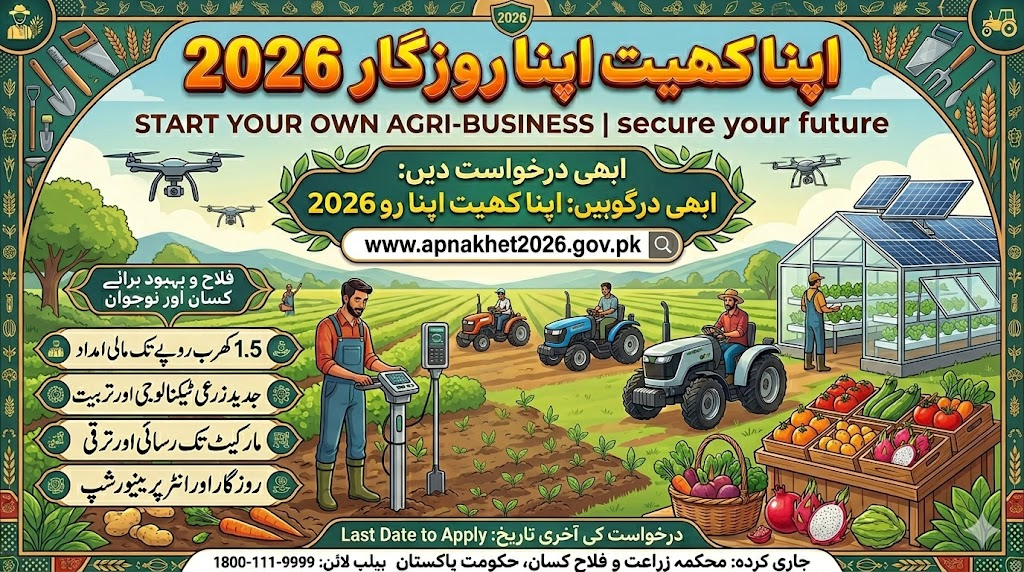
The program integrates land allotment with a broader support package covering the Kisan Card facility, Green Tractor Scheme access, agricultural training through new tehsil-level Centres of Excellence, and interest-free loans for seeds and inputs. The scheme is administered through the Punjab Enterprise Land Record Authority (PELRA), using the province’s digitized land records infrastructure.
This is not simply a land distribution program. It is, as policy analysts have noted, a complete transformation package — combining land access with financial tools, modern machinery, technical training, and market linkages into one integrated initiative designed to give deserving families everything they need to succeed.
The Vision Behind the AKAR Scheme: Why This Matters for Rural Pakistan
Pakistan has one of the highest rates of rural poverty in South Asia. The majority of the population in Punjab’s countryside either does not own land or owns plots too small to sustain a family. For decades, sharecropping and contract farming arrangements kept farmers perpetually indebted to large landowners, with little hope of breaking the cycle.
This digital backend is structurally different from past land reform attempts, which depended on manual district-level record-keeping that large landowners and local officials could manipulate. The PELRA database and computerized balloting system remove the two weakest links in that chain.
What makes the apna khet apna rozgar 2026 apply online initiative different from its predecessors is precisely this commitment to transparency and digital administration. Previous land schemes failed not because the land was unavailable, but because the distribution process was captured by middlemen, corrupt officials, and politically connected individuals. The AKAR scheme specifically addresses this structural problem by moving the entire process — registration, verification, balloting, and allotment — onto a digital platform that minimizes human interference.
Policy experts consider this program more sustainable than past subsidy schemes because it combines land ownership, financial access, and technical support under one model.
The announcement of the scheme was made during an official event held in Rajanpur — itself a symbolically important choice, since Rajanpur is one of Punjab’s most historically disadvantaged districts, with high rates of rural poverty and a large population of landless agricultural workers. The announcement was made during an official event in Rajanpur, where the Chief Minister stated that government resources must benefit the poor and hardworking people of Punjab.
Key Facts and Figures at a Glance
Before diving into the details, here is a quick summary of the most important facts about the AKAR scheme:
| Detail | Information |
|---|---|
| Scheme Name | Apna Khet Apna Rozgar (AKAR) Scheme 2026 |
| Launched By | CM Punjab Maryam Nawaz Sharif |
| Launch Date | February 2026 (officially notified April 21, 2026) |
| Total Land Being Distributed | 124,000+ acres (Phase 1) |
| Total Scheme Value | Approximately Rs. 160 billion |
| Target Beneficiaries | 50,000 to 88,000 families |
| Land Per Applicant | 3 to 10 acres |
| Lease Duration | 10 years |
| Annual Rent | Rs. 100 per acre |
| Age Requirement | 18 to 35 years (up to 55 for some categories) |
| Districts Covered | All 36 districts of Punjab |
| Online Registration Window | May 2, 2026 to May 18, 2026 |
| Official Portal | akar.pulse.gop.pk |
| Appeals Window | June 1 to June 8, 2026 |
| Final Selection Announcement | June 19, 2026 |
| Land Distribution Begins | June 30, 2026 |
| Helpline | 042-111-111-111 |
| Selection Method | Computerized balloting |
Objectives of the Apna Khet Apna Rozgar Scheme
The AKAR scheme is built around several interconnected objectives that address the root causes of rural poverty in Punjab:
Reducing Rural Unemployment: One of the central aims is to convert unemployed rural youth and landless workers into productive, self-employed farmers. By giving them access to cultivable land with supporting resources, the government creates a pathway from unemployment to sustainable self-employment that does not depend on the formal job market.
Increasing Agricultural Productivity: Large tracts of government-owned land in Punjab have sat uncultivated for years. The program covers all 36 districts of Punjab, with 13,812 agricultural plots identified across various districts and an additional 16,685 plots in the Cholistan region. Land selection prioritizes water availability and soil fertility to ensure viable cultivation outcomes. By bringing this idle land into productive use, the scheme directly boosts Punjab’s agricultural output and contributes to national food security.
Poverty Reduction and Economic Empowerment: With 124,000+ acres of prime agricultural land worth Rs160 billion being distributed, this initiative has the potential to transform nearly 190,000 families across the province. When a family moves from being a landless laborer to a land-holding farmer, the economic transformation is not limited to that household — it ripples outward through local markets, supplier networks, and rural communities.
Modernizing Agriculture: By linking land allotment with the Kisan Card, the Green Tractor Scheme, and agricultural training programs, the AKAR scheme ensures that new land recipients have access to modern farming inputs and techniques rather than simply receiving raw land with no support.
Promoting Food Security: As more land comes under cultivation by motivated small farmers supported by government inputs, Punjab’s overall agricultural output increases — reducing food imports, stabilizing prices, and strengthening Pakistan’s broader food security position.
Full Eligibility Criteria: Who Can Apply?
Understanding the eligibility requirements is critical before you begin the process of apna khet apna rozgar 2026 apply online. The Punjab government has established clear and specific criteria to ensure that land reaches those who genuinely need and deserve it.
Primary Eligibility Requirements
To qualify for the Apna Khet Apna Rozgar Scheme, applicants must meet the following conditions established by the Punjab government: Permanent Residency — must be a permanent resident of Punjab with valid CNIC or domicile; Age Limit — between 18 and 35 years (extended up to 55 years for certain categories); Land Status — must be completely landless or own very small agricultural land; Credit History — must not be a defaulter of any bank or financial institution; Farming Knowledge — should demonstrate basic farming experience or agricultural background.
Let us look at each criterion in more detail:
Pakistani Citizenship and Punjab Domicile: The applicant must be a Pakistani national with a valid, computerized National Identity Card (CNIC). Crucially, you must be a permanent resident of Punjab. Your domicile certificate must reflect Punjab as your home province. This requirement is strictly verified through official government databases, so any attempt to misrepresent your residency status will be detected and result in permanent disqualification.
Age Requirement: The standard age range is 18 to 35 years. However, certain categories — including widows, divorced women, and individuals with special circumstances — may be eligible up to the age of 55 years. If you are slightly above 35, do not dismiss your application without first checking whether you fall within an extended category.
Land Status — The Core Requirement: Eligible applicants must be landless or own maximum 10 marlas residential property, be permanent residents of the revenue estate, and have no prior government allotments. This is the single most important eligibility criterion. The scheme is specifically designed for landless individuals and families. If you already own agricultural land above the specified threshold, you do not qualify. The government verifies land ownership through the PLRA (Punjab Land Records Authority) database, which means any attempt to hide existing land holdings will be caught during the verification process.
No Prior Government Allotments: If you have previously received any land allotment, grant, or similar benefit from any government scheme, you are not eligible to apply. The government is committed to reaching those who have never had the opportunity to benefit from such programs before.
No Bank Loan Defaults: Applicants must have a clean credit history with no outstanding bank loan defaults. This requirement is meant to ensure that beneficiaries are capable of managing the financial responsibilities that come with farming, including seasonal input financing through the Kisan Card.
Farming Background or Interest: Valid Punjab domicile certificate required. Preference for landless individuals or small landholders (less than 2 acres). Basic farming knowledge or demonstrated commitment to agriculture. You do not need a formal agricultural degree, but you should be able to demonstrate either past farming experience or a clear, credible commitment to taking up cultivation on the allocated land.
Gender Equality: Both men and women can apply, including widows, divorced women, or disadvantaged applicants. The scheme explicitly encourages women, particularly widows and women from economically disadvantaged backgrounds, to apply. This is a significant departure from traditional land programs that effectively excluded women from consideration.
Who Is NOT Eligible?
Applicants who own large agricultural land holdings, have criminal records, or are existing loan defaulters are not eligible for this scheme.
Additionally, individuals who are not permanent residents of the revenue estate where the available land is located, or those who have previously received government land allotments under any earlier scheme, will have their applications rejected during the verification process.
Required Documents: Complete Checklist
Preparing your documents in advance is one of the most important things you can do to ensure a smooth application process. Many applications are rejected each year due to missing documents, incorrect information, or incomplete uploads, so careful preparation is important.
Here is the complete list of documents required for apna khet apna rozgar 2026 apply online:
Identity Documents:
- Original valid Computerized National Identity Card (CNIC) — both sides, clearly photographed or scanned
- Recent passport-sized photographs (typically 2 to 4 copies, taken within the last three months)
Residency and Domicile Documents:
- Valid Punjab domicile certificate
- Proof of permanent residence in the revenue estate where you are applying
- Utility bill or any official document confirming your current address
Land Status Documents:
- If you are completely landless: an affidavit confirming you do not own any agricultural land, signed before a notary or oath commissioner
- If you manage someone else’s land: any tenancy or contract agreement (confirm current requirements through the official portal)
- Land records or Fard (if applicable) showing your current land holdings
Financial Documents:
- Bank account details (active bank account in your name)
- Statement or declaration confirming you are not a loan defaulter
- Any income-related documentation showing your current financial situation
Agricultural Background:
- Any document supporting your farming experience or background (no formal certification is usually required, but it helps your application)
Additional Documents for Specific Categories:
- Widows: death certificate of husband, marriage certificate
- Divorced women: divorce deed or legal documentation
- Special persons: disability certificate from NADRA or relevant authority
CNIC details are verified through NADRA systems to confirm identity. Punjab domicile records are also checked to confirm residency eligibility. Land ownership or tenancy documents are verified through revenue department records.
Important Warning: Once an application under the Apna Khet Apna Rozgar Scheme is submitted, uploaded documents cannot be edited, replaced, or re-uploaded. The system locks all submitted information to maintain transparency and prevent manipulation after verification begins. This means you must have all your documents correct and complete before you click the Submit button. There is no going back.
The Official Online Portal: Understanding akar.pulse.gop.pk
The entire registration process for apna khet apna rozgar 2026 apply online is conducted through the official PLRA Pulse Portal. The akar.pulse.gop.pk Login Portal 2026 for Apna Khet Apna Rozgar 2026 allows users to register, apply online, and track their application status easily through a simple and transparent system for farmers in Punjab.
The scheme is administered through the Punjab Enterprise Land Record Authority (PELRA), using the province’s digitized land records infrastructure. Land data for available state agricultural land is being uploaded to the Punjab Agriculture Department’s official portal at agripunjab.gov.pk, where applicants can also cross-reference available land in their revenue estate.
The portal is designed to be accessible even for those with limited digital literacy. However, given the significance of this application, it is strongly recommended that you have someone experienced with online forms help you if you are not comfortable with digital processes. Many district administration offices are also providing facilitation centers where government staff can assist applicants.
Step-by-Step Guide to Applying Online
The following is the complete, step-by-step process for apna khet apna rozgar 2026 apply online through the official portal:
Step 1 — Visit the Official Portal
Navigate to the official government website at akar.pulse.gop.pk. You can also access it through akar.punjab.gov.pk. Make absolutely sure you are on the correct government website before entering any personal information. Look for the official .gov.pk or .gop.pk domain extension. Beware of fake websites that mimic the official portal to collect personal data.
Step 2 — Create Your Account
Enter your CNIC number and active mobile number to create your login account. You will receive a verification code on your phone via SMS. Enter this OTP (One-Time Password) code to verify your mobile number and complete the account creation process. Use a mobile number that you regularly use and can access, because all future communications — including your tracking number, status updates, and final decision notification — will be sent to this number.
Step 3 — Complete Your Profile
Fill in all personal details accurately — your name, address, district, tehsil, family information, and farming background. Every piece of information you enter here will be cross-referenced against official government databases. If the name on your CNIC differs from what you enter, if your address does not match your domicile record, or if your land status does not align with PLRA records, your application will be flagged for rejection. Accuracy is paramount.
Step 4 — Fill the Application Form
Enter all required information in the online application form, including your land status, income level, current employment situation, family size, and the district and tehsil where you wish to receive land. If you have a preference for a particular area, indicate it clearly, but understand that final allotment is subject to land availability in that revenue estate.
Step 5 — Upload Required Documents
Scan and upload clear, legible copies of all required documents. Blurry or incomplete uploads can cause rejection. Before uploading, check that each document is clearly readable. Avoid using photos taken in poor lighting, at angles, or with shadows across the text. The system typically accepts PDF, JPG, and PNG formats.
Step 6 — Submit Your Application
Review the entire form one final time and then submit it. You will receive a tracking number via SMS. Save this tracking number — it is your reference for all future inquiries about your application. Write it down in a safe place or screenshot it.
Step 7 — Track Your Application Status
To check your Apna Khet Apna Rozgar Scheme 2026 application status, visit the official AKAR Pulse Portal and log in using your CNIC number and the password you created during registration. After logging in, your applicant dashboard will open, where you can view your current application status next to your profile details.
The possible status indicators are:
- Submitted — Your application has been received by the system
- Under Verification — Government officials are reviewing your documents
- Shortlisted — You have passed the initial screening process
- Balloting Pending — Your application is in the queue for the computerized draw
- Selected — Congratulations, you have been chosen for land allotment
- Rejected — Your application was not approved (you may be eligible to file an appeal)
Important Dates and Timeline
The Punjab Government has launched the Apna Khet Apna Rozgar Scheme, a major initiative to support landless farmers by providing agricultural land on a 10-year lease. Online applications can be submitted from 2 May to 18 May through the official portal akar.pulse.gop.pk. Applicants who are not shortlisted will be able to file appeals at their respective Deputy Commissioner offices between 1 June and 8 June. The final list of successful candidates will be announced on 19 June, while the distribution of over 125,000 acres of land will begin from 30 June, aiming to boost agriculture and create sustainable livelihood opportunities across Punjab.
| Milestone | Date |
|---|---|
| Online Registration Opens | May 2, 2026 |
| Online Registration Closes | May 18, 2026 |
| Verification Period | Late May to Early June 2026 |
| Appeals Window Opens | June 1, 2026 |
| Appeals Window Closes | June 8, 2026 |
| Final Selection List Published | June 19, 2026 |
| Land Distribution Begins | June 30, 2026 |
Note: Since the online registration window officially closed on May 18, 2026, the focus for many readers now shifts to tracking existing applications, filing appeals if necessary, and preparing for the land allotment and development phase beginning June 30.
How the Selection Process Works: Computerized Balloting Explained
One of the most praised aspects of the AKAR scheme is its transparent, technology-driven selection process. Unlike past schemes where land distribution was often determined by political connections, local bureaucratic discretion, or outright corruption, the AKAR scheme uses a computerized balloting system administered by PELRA.
This program benefits 50,000 families through transparent computerized balloting.
Here is how the selection process works step by step:
Initial Screening: Once you submit your application through apna khet apna rozgar 2026 apply online, it enters an automated verification pipeline. Your CNIC is checked against NADRA records. Your domicile is verified against Punjab’s domicile database. Your land ownership status is cross-referenced with PLRA land records. Your bank loan history may be checked through the State Bank or relevant financial authority.
Shortlisting: Applications that pass all verification checks are shortlisted. Applications with incorrect information, missing documents, or failed verification checks are rejected at this stage.
Balloting: In cases where multiple applicants apply for the same plot, a balloting system will be used to ensure fairness. This method prevents bias and ensures equal chances for all eligible candidates. The allocation process is transparent and follows clear guidelines. The computerized balloting system randomly assigns plots to eligible applicants, giving every verified application an equal mathematical chance of selection.
Notification: Selected applicants are notified via SMS to their registered mobile number and through the official portal. Rejected applicants also receive notification and are informed of the appeals process.
Appeals: Applicants who are not shortlisted will be able to file appeals at their respective Deputy Commissioner offices between 1 June and 8 June. If you believe your application was incorrectly rejected, you have the right to file a formal appeal with the DC office in your district during this window.
The Complete Benefits Package: Far More Than Just Land
The land allocation itself — 3 to 10 acres at Rs. 100 per acre per year — is extraordinary. But the apna khet apna rozgar 2026 apply online program goes well beyond simply handing over a piece of ground and wishing you luck. The government has constructed a comprehensive support package that addresses every major barrier to successful farming.
Agricultural Development Grants
Under this transformative scheme, eligible beneficiaries receive agricultural plots valued between Rs2.5 million to Rs4 million on a 10-year lease, accompanied by one-time development grants ranging from Rs50,000 to Rs250,000 per acre to support initial cultivation costs.
Eligible farmers may receive grants ranging from Rs. 500 to Rs. 250,000 per acre for land preparation and rehabilitation. These development grants cover essential startup costs like land clearing, leveling, irrigation channel construction, and soil preparation — expenses that are often prohibitively high for a new farmer with no capital.
The Kisan Card — Your Key to Subsidized Agricultural Inputs
The Kisan Card gives allottees access to subsidized agricultural inputs — seeds, fertilizers, pesticides — purchased directly from registered suppliers at subsidized rates, removing the intermediary layer that has historically diverted input subsidies before they reach small farmers.
Selected beneficiaries may qualify for the CM Kisan Card, which offers interest-free seasonal loans for seeds, fertilizer, and pesticides. This is a critical benefit because one of the most common reasons small farmers fail is not lack of land but lack of affordable access to quality inputs. The Kisan Card eliminates this barrier by providing a direct digital payment mechanism that bypasses middlemen entirely. apna khet apna rozgar online registration
Green Tractor Scheme Integration
Modern farming requires modern equipment. The Green Tractor Scheme connected with Apna Khet Apna Rozgar provides: Tractor Subsidy — up to Rs 1,000,000 subsidy on new tractors (50-65 HP models); Zero Interest — completely interest-free financing for land allottees; Equipment Support — subsidies for laser land levelers, seeders, and harvesting equipment; Repayment Terms — flexible payment schedules aligned with harvest seasons; Shared Machinery — access to government-owned machinery for those who don’t need individual tractors.
Beneficiaries may receive priority access to the Green Tractor Scheme, with subsidies of up to Rs. 1 million. Access to mechanized farming is often what separates subsistence farming from commercially viable agricultural production. A farmer with a tractor can cultivate far more land, plant on time, harvest efficiently, and reduce the labor costs that eat into net income.
Monthly Stipend During Establishment Period
70,000 monthly stipend is available for selected beneficiaries during the initial period while their crops are being established. This critical support prevents families from abandoning their allotted land due to financial pressure during the early months before their first harvest.
Agricultural Training Through Centres of Excellence
Agricultural training through new tehsil-level Centres of Excellence provides beneficiaries with practical knowledge on modern farming techniques, crop rotation, pest management, water conservation, and market-oriented agriculture. Agriculture officers and graduate interns will provide support at the field level to guide new land recipients through their first growing seasons.
Market Linkages
Selected beneficiaries receive land allotment, Green Tractor subsidies, agricultural training, and market linkages. One of the persistent problems for small farmers in Pakistan is the inability to access fair markets. Large traders and middlemen often buy produce at exploitative prices from farmers who have no alternative buyers. The AKAR scheme addresses this by building market linkages that connect new land allottees directly to agricultural markets, processors, and buyers.
Land Availability: Where Is the Land Located?
The program covers all 36 districts of Punjab, with 13,812 agricultural plots identified across various districts and an additional 16,685 plots in the Cholistan region.
The geographical spread of available land is one of the most important factors to understand when you complete apna khet apna rozgar 2026 apply online. Different districts have varying amounts of available state-owned land, different soil conditions, different water availability, and different agro-climatic zones suited to different crops.
Land selection prioritizes water availability and soil fertility to ensure viable cultivation outcomes. The government has specifically selected plots that have access to irrigation — either through canal systems, tube wells, or other water sources — because dry land without irrigation cannot support sustainable farming.
The Cholistan region deserves special mention. An additional 16,685 plots in the Cholistan region represent a massive opportunity to transform what has historically been desert or semi-arid land into productive agricultural territory through modern farming techniques and irrigation infrastructure.
Priority in land allotment is typically given to applicants who are permanent residents of the revenue estate where the available land is located. This means that if government land is available in your home tehsil or district, you have a higher chance of receiving it than an applicant from outside the area.
Understanding the 10-Year Lease: Rights and Responsibilities
A crucial point that every applicant must clearly understand is that the AKAR scheme provides a lease on government-owned land — not permanent ownership or title transfer.
The land is provided on a 10-year lease, not permanent ownership.
This distinction matters enormously for how you plan your farming activities:
What the Lease Allows:
- You have the right to cultivate the allotted land for your own benefit for the full 10-year period
- You can grow any crops, raise livestock, or conduct any legal agricultural activity on the land
- You can access all scheme benefits (Kisan Card, Green Tractor Scheme, agricultural training) tied to the allotment
- Your family members can work on the land with you
- Your children may be eligible for lease renewal after the initial 10-year period, subject to future government policy
What the Lease Does NOT Allow:
- Allocated land must be used strictly for agricultural purposes. It cannot be sold, leased, or transferred to another person. The Punjab Agriculture Department may conduct monitoring visits to ensure proper land use.
- You cannot sublet the land to another party
- You cannot use the land as collateral for private loans
- You cannot build permanent residential structures on the land without government approval
- Failure to cultivate the land actively may result in cancellation of your allotment
Geographic Coverage: All 36 Districts of Punjab
The apna khet apna rozgar 2026 apply online program is truly provincial in scope — covering all 36 districts of Punjab without exception. Here is a general overview of how the scheme impacts different regions:
Northern Punjab Districts (Rawalpindi, Attock, Jhelum, Chakwal): These areas have more hilly terrain, but government land in valley floors and plains is identified for distribution. Water availability from rainfall and smaller river systems supports certain crops.
Central Punjab Districts (Lahore, Gujranwala, Sialkot, Faisalabad, Sargodha): The agricultural heartland of Punjab. Canal irrigation networks here are among the most developed in Pakistan. Plots in these districts are highly sought after.
Southern Punjab Districts (Multan, Bahawalpur, Rahim Yar Khan, DG Khan, Muzaffargarh): These are the regions with the highest concentration of rural poverty and landless farmers. The scheme places particular emphasis on reaching families in South Punjab. The Cholistan region, administratively part of Bahawalpur, contains thousands of the newly identified plots.
Western Punjab Districts (Bhakkar, Layyah, Mianwali): These districts have large stretches of state-owned land that have historically been underutilized. The AKAR scheme brings significant opportunities to communities in these areas.
Comparison with Previous Government Schemes
To fully appreciate why the AKAR scheme is generating such extraordinary public interest, it helps to compare it with previous attempts at agricultural land distribution and rural poverty alleviation.
Previous Subsidy Schemes: Earlier programs that provided agricultural subsidies often failed because the subsidized inputs — fertilizers, seeds, pesticides — were diverted by middlemen and resold at market prices before reaching small farmers. The Kisan Card model eliminates this by creating a direct digital transaction between the government and the farmer.
Traditional Land Reforms: Land reform efforts under various governments from the 1950s onward struggled with implementation. Past land reform attempts depended on manual district-level record-keeping that large landowners and local officials could manipulate. The AKAR scheme’s use of the PELRA digital database removes this vulnerability.
Employment Schemes: Cash-based employment schemes provided temporary relief but created no lasting asset base for beneficiaries. Land, by contrast, is a productive asset that generates income season after season when properly cultivated.
What Makes the AKAR Scheme Different: The combination of digital administration, computerized balloting, integrated support packages, and a monitoring mechanism for land use creates a program that is structurally more robust than anything Punjab has attempted before. Policy experts consider this program more sustainable than past subsidy schemes because it combines land ownership, financial access, and technical support under one model.
Supported Agricultural Activities
The AKAR scheme does not restrict you to a single type of farming. You have the flexibility to choose the agricultural activity best suited to your skills, the soil conditions of your allotted land, and local market demand. Supported activities include:
Crop Farming:
- Wheat, rice, maize, and other staple grain crops
- Cotton and sugarcane for commercial value
- Seasonal vegetables including tomatoes, potatoes, onions, and chilies
- Oilseeds like sunflower and canola
- Fruits and orchards where climate and soil conditions allow
Livestock and Dairy Farming:
- Dairy operations with cows and buffaloes
- Meat production through cattle or goat rearing
- Integrated crop-livestock farming systems where fodder crops feed animals and animal waste fertilizes crops
Poultry:
- Commercial poultry units for egg or broiler meat production
- Layer farming combined with crop cultivation
Horticulture and High-Value Crops:
- Vegetable cultivation under tunnels or open fields
- Medicinal herb cultivation where market demand exists
- Seed multiplication for certified agricultural seed programs
Agro-Processing:
- Small-scale value-addition activities tied to primary agriculture, where scheme rules permit
Common Mistakes That Lead to Rejection
Many applicants who go through apna khet apna rozgar 2026 apply online face rejection for entirely avoidable reasons. Understanding these common mistakes in advance can dramatically improve your chances:
Providing Incorrect Personal Information: Your name, father’s name, date of birth, and CNIC number must match NADRA records exactly. Even a minor spelling difference between your application and your CNIC can cause problems. Copy your personal information directly from your CNIC rather than typing from memory.
Using an Inactive Mobile Number: All communications are sent to your registered number. If you change your phone number or let your SIM become inactive, you may miss critical updates including your tracking number, status changes, and land allotment notice.
Uploading Blurry or Incomplete Documents: Blurry or incomplete uploads can cause rejection. Scan documents in good lighting, ensure all text is clearly readable, and double-check every uploaded file before submitting.
Submitting False Land Ownership Information: The system cross-references your land status declaration against PLRA records. If you claim to be landless but PLRA records show you own agricultural land above the threshold, your application will be rejected and you may face permanent disqualification.
Applying for Land Outside Your Revenue Estate: Priority is given to permanent residents of the revenue estate where the available land is located. Applying for land in a district or tehsil where you are not registered as a permanent resident significantly reduces your chances.
Paying Money to Agents or Middlemen: The entire Apna Khet Apna Rozgar Program 2026 Online Registration process is completely free. Do not pay money to any agent or middleman. Anyone who claims they can guarantee your selection in exchange for money is a fraud. The selection is conducted by computerized balloting and cannot be influenced by intermediaries.
Missing the Deadline: The registration window for apna khet apna rozgar 2026 apply online ran from May 2 to May 18, 2026. Applications submitted after this deadline are not considered.
How to Track Your Application Status
To check your Apna Khet Apna Rozgar Scheme 2026 application status, visit the official AKAR Pulse Portal and log in using your CNIC number and the password you created during registration. After logging in, your applicant dashboard will open, where you can view your current application status next to your profile details.
You can also track your status through:
SMS Updates: The system sends automatic SMS notifications to your registered mobile number whenever your application status changes. Ensure your phone is active and receiving messages.
Helpline: Helpline: 042-111-111-111. If you are unable to access the portal or need assistance tracking your status, the official helpline is available to assist applicants.
District Administration Offices: If you face technical difficulties with the online portal, you can visit your local district administration office or tehsil headquarters, where facilitation desks have been set up to assist applicants.
Appeals Process: What to Do If Your Application Is Rejected
Rejection is not necessarily the end of the road. The government has built a formal appeals mechanism into the AKAR scheme to ensure that applicants who believe their application was incorrectly rejected have a fair opportunity to challenge that decision.
Applicants who are not shortlisted will be able to file appeals at their respective Deputy Commissioner offices between 1 June and 8 June.
If your application for apna khet apna rozgar 2026 apply online is rejected, here is what you should do:
Step 1 — Understand the Reason for Rejection: Check your portal dashboard or SMS notification to understand why your application was rejected. Common reasons include: CNIC verification failure, land ownership conflict with PLRA records, incomplete documents, outside the eligible age range, or prior government land allotment on record.
Step 2 — Gather Evidence: If you believe the rejection was an error — for example, if PLRA records incorrectly show you as a land owner when you do not own any agricultural land — gather all documentary evidence that supports your claim. Revenue records, court orders, or other official documents may be relevant.
Step 3 — File an Appeal: Visit your District Commissioner’s office in person between June 1 and June 8, 2026. Submit a written appeal along with your supporting documents. Ensure you receive a written acknowledgment of your appeal submission.
Step 4 — Follow Up: After submitting your appeal, follow up with the DC office before the final list is published on June 19 to understand the status of your appeal.
Role of PLRA and the Digital Infrastructure
The Punjab Land Records Authority (PLRA) is the backbone of the AKAR scheme’s transparent and efficient operation. Understanding how PLRA underpins the entire process helps applicants appreciate why accuracy in their applications is so important.
PLRA maintains digitized records of land ownership across all of Punjab’s revenue estates. This database is the definitive reference for determining who owns what land in Punjab. When you claim to be landless on your AKAR application, the system automatically queries the PLRA database against your CNIC to verify that claim. If PLRA records show any agricultural land registered in your name, your application is flagged.
The system may automatically verify your land through PLRA PULSE database. This automation means the verification process is not dependent on individual officials — it is a digital check that applies uniformly to every application.
The integration of PLRA’s land records with NADRA’s identity database and the Punjab agriculture department’s support systems creates a comprehensive digital ecosystem that makes the scheme’s administration far more robust than any manual process could be.
Impact on Rural Economy and Agricultural Sector
The AKAR scheme is expected to produce transformative effects on Punjab’s rural economy that extend well beyond the immediate beneficiaries.
Direct Economic Impact: When 50,000 to 88,000 families receive productive land and the tools to farm it effectively, they collectively generate enormous economic activity. They purchase seeds, fertilizers, and equipment from local suppliers. They hire seasonal labor during planting and harvest periods. They sell produce in local markets, increasing supply and moderating food prices.
Multiplier Effect: Each farming family that becomes economically productive creates economic activity for 5 to 10 other households through supply chains, labor employment, and market transactions. The scheme’s full economic impact, therefore, could benefit anywhere from 500,000 to 900,000 people across Punjab.
Food Security: By converting unused state land into productive farmland, the scheme aims to create sustainable economic growth across Punjab. As hundreds of thousands of previously idle acres come under cultivation, Punjab’s agricultural output increases — directly contributing to national food security and reducing dependence on food imports.
Poverty Reduction: For thousands of families across Punjab, this scheme offers more than just land. It creates a real opportunity to build a stable livelihood through farming, access government grants, and benefit from agricultural support programs. For families that have lived in poverty for generations, the ability to own and cultivate productive land represents a fundamental change in their economic trajectory.
Agricultural Crop Options and Revenue Potential
Understanding the potential income from different crops can help you make an informed decision about what to cultivate on your allotted land:
Wheat: The most widely grown crop in Punjab. On 3 to 5 acres with proper inputs, a farmer can expect to produce enough wheat to meet household consumption needs and sell the surplus. Average yield per acre with proper farming is 30 to 40 maunds.
Sugarcane: A high-value commercial crop that requires good water supply but delivers strong returns. Sugar mills provide a guaranteed market, making revenue more predictable than open-market crops.
Vegetables: High-value, short-cycle crops that can generate income multiple times per year. Tomatoes, potatoes, onions, and chilies are particularly profitable in Punjab’s climate and market conditions.
Dairy Farming: Combining land cultivation with dairy animals on the same plot creates a year-round income stream. Fodder grown on the land feeds the animals, and milk sales provide monthly income.
Fruit Orchards: Mango, citrus, and guava orchards require several years to mature but then provide income for decades. Applicants with patience and long-term vision might consider fruit cultivation on at least a portion of their allotted land.
Women’s Participation in the AKAR Scheme
The inclusion of women — and particularly vulnerable women such as widows and divorced women — as priority applicants is one of the most socially significant aspects of the AKAR scheme.
Both men and women can apply, including widows, divorced women, or disadvantaged applicants.
Women-headed households in rural Punjab are among the most economically marginalized communities in Pakistan. They often lack the social capital, financial resources, and legal standing to access government programs that benefit men. The AKAR scheme explicitly addresses this by:
Including women in the eligible applicant pool with no restrictions based on gender. Giving priority consideration to widows and divorced women who face particular economic hardship. Allowing women to register accounts and submit applications independently without requiring a male guardian’s involvement. Ensuring that land allotted to women applicants is registered in the woman’s name, not a male family member’s name.
This approach has the potential to create a lasting shift in the economic status of women-headed households across rural Punjab, because land ownership in a woman’s name gives her legal standing, collateral for future financing, and economic independence that is transformative for her and her children.
Monitoring and Accountability Mechanisms
The government has built monitoring and accountability mechanisms into the AKAR scheme to ensure that allotted land is actually being cultivated and that the scheme’s benefits reach their intended recipients.
The Punjab Agriculture Department may conduct monitoring visits to ensure proper land use. Agriculture officers assigned to each revenue estate are responsible for conducting periodic checks on allotted plots to verify that cultivation is underway. Beneficiaries who fail to cultivate their land — who receive the allotment but then leave it idle — risk having their allotment cancelled and the land reallocated to another deserving family.
Agriculture officers and graduate interns will provide support during these monitoring visits, offering guidance and assistance rather than just oversight. The emphasis is on helping new farmers succeed, not on catching and punishing them for difficulties.
This combination of support and accountability is what distinguishes the AKAR scheme from purely top-down programs that distribute assets without any follow-through on their productive use.
Tips to Maximize Your Chances of Success
If you have already submitted your application through apna khet apna rozgar 2026 apply online or are preparing to apply, here are evidence-based tips to strengthen your position:
Prepare Documents Early: Do not wait until the last moment. Gather all required documents well in advance, have them scanned and organized in digital files, and check each one for clarity and validity.
Verify Your PLRA Land Records in Advance: Before applying, visit your local PLRA office or use the PLRA online system to check what land records are associated with your CNIC. If there are any errors — old records that incorrectly attribute land to you — get them corrected before you apply.
Use Official Channels Only: The entire process is completely free. Do not pay money to any agent or middleman. Anyone promising to guarantee your selection for a fee is lying. The selection is computerized and no individual can influence it.
Apply in Your Home Revenue Estate: Your chances of selection are significantly higher if you apply for land located in the revenue estate where you are officially registered as a permanent resident.
Keep Your Phone Active: Your registered mobile number is your lifeline to updates about your application. Do not change your number or let your balance run out during the application and verification period.
Respond Promptly to Verification Requests: If government officials contact you for additional information or document verification, respond quickly and cooperatively. Delays in responding to official requests can result in your application being deprioritized or rejected.
Frequently Asked Questions (FAQs)
What is the Apna Khet Apna Rozgar Scheme 2026?
It is a Punjab Government scheme providing 3–5 acres of agricultural land to landless farmers and rural youth for sustainable farming and income generation. The scheme was launched by CM Maryam Nawaz Sharif and is administered through the PLRA Pulse Portal.
Who is eligible to apply for the AKAR Scheme?
Must be a permanent resident of Punjab with a valid domicile certificate; must hold a valid and active Computerized National Identity Card (CNIC); should be landless or own less than 2 acres of agricultural land; age should be between 18 and 35 years at the time of application; must have a basic interest or experience in farming and agricultural activities; must not be a defaulter on any government or bank loan; both men and women are fully eligible to apply.
Is the online registration free of charge?
Yes, the entire Apna Khet Apna Rozgar Program 2026 Online Registration process is completely free. Do not pay money to any agent or middleman.
Can women apply for the scheme?
Yes. Both men and women can apply, including widows, divorced women, or disadvantaged applicants.
What documents are required?
You will need your original CNIC, Punjab domicile certificate, recent photographs, active mobile number, bank account details, and supporting documents related to land ownership or landless status.
Can I edit my application after submission?
No. Once an application under the Apna Khet Apna Rozgar Scheme is submitted, uploaded documents cannot be edited, replaced, or re-uploaded. The system locks all submitted information to maintain transparency and prevent manipulation after verification begins.
How is the land allocated?
In cases where multiple applicants apply for the same plot, a balloting system will be used to ensure fairness. This method prevents bias and ensures equal chances for all eligible candidates.
What is the duration of the land lease?
The land is provided on a 10-year lease, not permanent ownership. The annual rent is just Rs. 100 per acre.
What additional benefits do selected beneficiaries receive?
Selected beneficiaries receive land allotment, Green Tractor subsidies, agricultural training, and market linkages. They also have access to the Kisan Card for interest-free agricultural input financing.
What happens if my application is rejected?
Applicants who are not shortlisted will be able to file appeals at their respective Deputy Commissioner offices between 1 June and 8 June.
How can I track my application status?
You can track your application through the official agripunjab.gov.pk portal using your CNIC or application reference number. SMS updates will also be sent to your registered mobile number.
Can allocated land be sold or transferred?
No. Allocated land must be used strictly for agricultural purposes. It cannot be sold, leased, or transferred to another person.
What is the official helpline for the scheme?
Helpline: 042-111-111-111.
How many families will benefit from this scheme?
This flagship program aims to distribute over 124,000 acres of government-owned agricultural land worth approximately Rs160 billion to more than 88,000 deserving families, creating sustainable self-employment opportunities through farming.
When will land distribution begin?
The distribution of over 125,000 acres of land will begin from 30 June, aiming to boost agriculture and create sustainable livelihood opportunities across Punjab.
Is there any income or employment requirement to apply?
The scheme is specifically designed for unemployed or underemployed individuals without agricultural land. There is no minimum income requirement — in fact, being economically disadvantaged strengthens your eligibility. The requirement is simply that you are landless or near-landless, a permanent Punjab resident, within the age range, without prior government land allotments, and without bank loan defaults.
The Broader Context: AKAR Scheme Within Punjab’s Agricultural Development Vision
The apna khet apna rozgar 2026 apply online initiative does not exist in isolation. It is part of a broader agricultural transformation agenda being implemented by the Punjab government under CM Maryam Nawaz Sharif. Several complementary programs are being implemented alongside the AKAR scheme:
CM Green Tractor Scheme: Launched by Chief Minister Maryam Nawaz Sharif in February 2026, it integrates land allotment with Kisan Card input subsidies, Green Tractor Scheme access, and agricultural training. The Green Tractor Scheme, now in its third phase, provides heavily subsidized tractors to small farmers who could not otherwise afford modern farming equipment.
Punjab Kisan Card Program: The Kisan Card digital payment system allows farmers to purchase subsidized agricultural inputs directly from registered suppliers without handling cash, eliminating the middlemen who have historically captured input subsidies intended for small farmers.
Tehsil-Level Agricultural Training Centres: New Centres of Excellence at the tehsil level bring agricultural extension services — previously available only in major cities or district headquarters — directly to rural communities.
Digital Land Records (PLRA): The ongoing digitization of Punjab’s land records under the PLRA is foundational to all of these programs. As more land records move into the digital system, it becomes progressively harder for local powerful interests to manipulate land ownership records or exclude deserving applicants from government schemes.
Together, these programs represent a coherent and ambitious effort to transform Punjab’s agricultural sector from one characterized by large landholdings, tenant farming, and low productivity into one driven by empowered small farmers with modern tools, fair market access, and government support.
Conclusion: A Transformative Opportunity — Are You Ready?
The apna khet apna rozgar 2026 apply online initiative is not just a government program. It is a historic opportunity — perhaps the most significant agricultural empowerment initiative in Punjab’s recent history — for landless farmers, unemployed rural youth, widows, and economically disadvantaged families to fundamentally change their circumstances through the productive power of land ownership and modern farming.
The Apna Khet Apna Rozgar scheme represents Chief Minister Maryam Nawaz Sharif’s vision to eliminate rural poverty through agricultural empowerment.
The numbers tell a compelling story. With 124,000+ acres of prime agricultural land worth Rs160 billion being distributed, this initiative has the potential to transform nearly 190,000 families across the province.
But the numbers are only part of the story. Behind every application submitted through apna khet apna rozgar 2026 apply online is a family whose members understand what land means in a rural economy — that it is not just soil and vegetation, but security, dignity, and the possibility of a better life. A family that farms its own land does not go hungry. A young man who cultivates his own plot does not need to migrate to the city in search of wages that may never materialize. A widow who receives her own land can raise her children with a measure of independence that changes their life trajectory entirely.
The registration window has closed, the verification process is underway, and the computerized balloting will determine which families receive land on June 30, 2026. For those who applied: check your status regularly through the official portal, keep your phone active for SMS notifications, and be ready to engage with the appeals process if necessary.
For those interested in future phases of the scheme: the government has made clear that this is only the first phase of a much larger program, with 1.24 million acres of government land eventually earmarked for distribution. Prepare your documents now so that when the next registration window opens, you are ready to submit a complete and accurate application without any rush or last-minute scrambling.
Applicants should carefully prepare documents and verify final details through official government channels before applying. Always rely on official announcements from the Punjab Agriculture Department and the official AKAR portal rather than on rumors, unofficial websites, or agents claiming special knowledge.
The land is there. The support is there. The opportunity is real. Whether you were able to complete apna khet apna rozgar 2026 apply online within the registration window, or you are positioning yourself for future phases of this program, the most important thing you can do right now is stay informed, stay engaged with official channels, and make sure you are ready when your moment comes.