
The apna khet apna rozgar online registration process has officially opened, and it represents one of the most significant rural empowerment initiatives in recent Pakistani history. Launched by Chief Minister Maryam Nawaz Sharif under the Government of Punjab, the AKAR Scheme — short for Apna Khet Apna Rozgar — promises to distribute approximately 250,000 acres of state-owned agricultural land to deserving, landless farmers and unemployed rural youth across all 36 districts of Punjab. This detailed guide breaks down everything you need to know: what the scheme offers, who qualifies, how the digital portal works, what documents to prepare, how the computerized balloting system functions, what support farmers receive after selection, and how to protect yourself from fraud during the registration process.
If you are a landless farmer, a rural youth struggling with unemployment, or a family surviving on daily wages with farming skills but no land of your own, this scheme was designed with you in mind. Understanding the complete picture — from eligibility criteria to post-allotment obligations — will significantly improve your chances of success.
What Is the Apna Khet Apna Rozgar Scheme?
The Apna Khet Apna Rozgar scheme represents Chief Minister Maryam Nawaz Sharif’s vision to eliminate rural poverty through agricultural empowerment. Announced during an official visit to Rajanpur, this program commits the Punjab government to distributing 250,000 acres of state-owned agricultural land to deserving, landless citizens across all districts of Punjab.
The name itself is a promise. “Apna Khet” means “My Own Farm.” “Apna Rozgar” means “My Own Employment.” Together, the phrase captures the soul of the program: giving ordinary rural citizens who have worked the land of others for generations the ability to work their own.
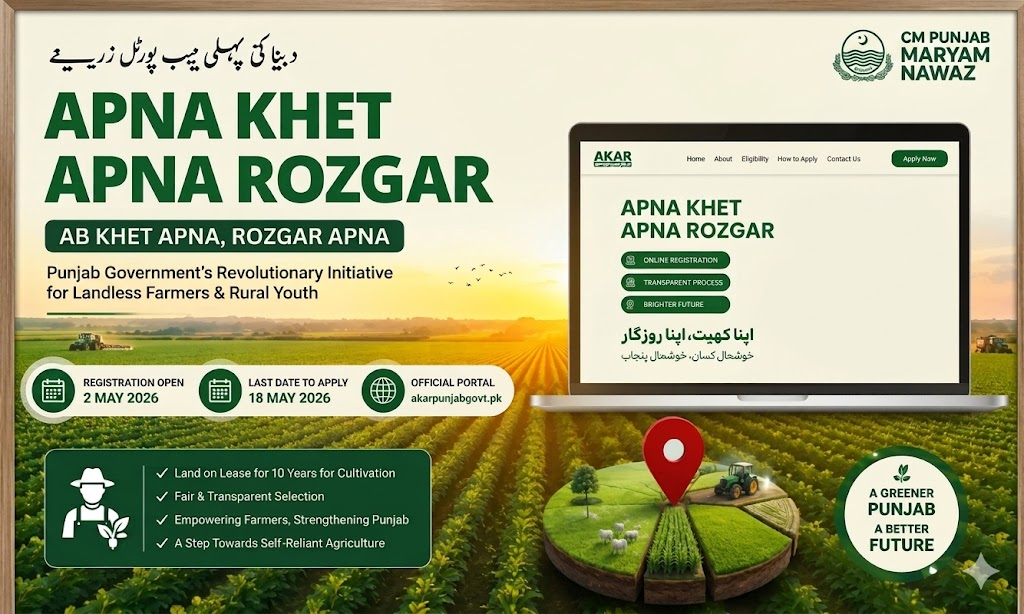
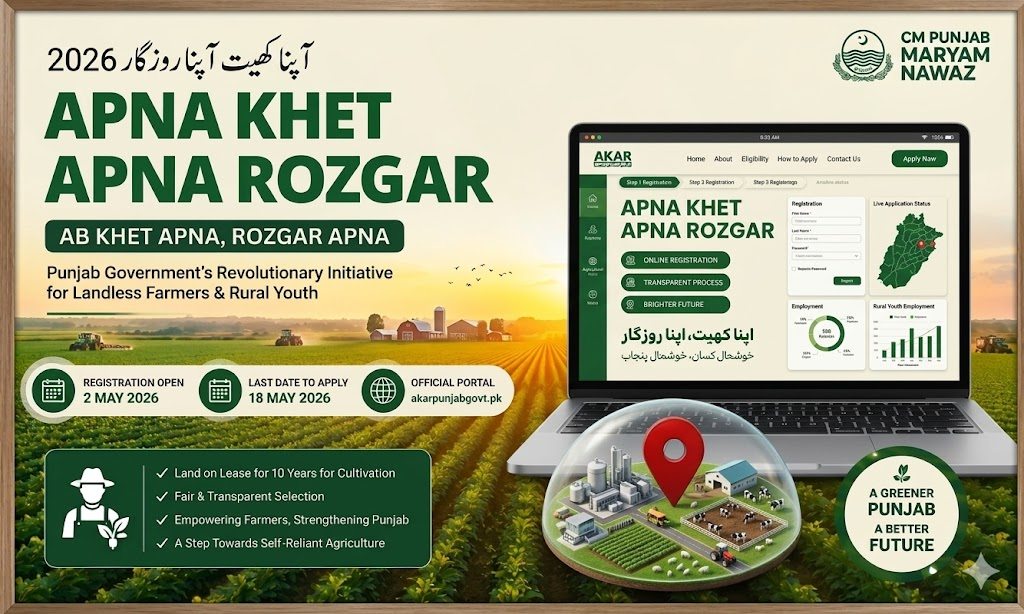
The AKAR Scheme offers landless Pakistani farmers 3 to 10 acres of government land on a 10-year lease at just Rs 100 per acre annually. Launched by CM Maryam Nawaz Sharif, this program benefits 50,000 families through transparent computerized balloting.
The Apna Khet Apna Rozgar Scheme, also known as the AKAR Scheme, is a provincial-level agricultural land distribution program designed to address rural unemployment and landlessness in Punjab. Officially approved on January 23, 2026, this initiative represents one of the largest land redistribution efforts in recent Pakistani history.
What separates this scheme from previous agricultural initiatives in Pakistan is its integrated approach. Rather than offering a single benefit — such as just a loan or just a subsidy — the AKAR Scheme bundles together land access, financial support, agricultural machinery assistance, expert training, market linkages, and ongoing government supervision. The apna khet apna rozgar online registration portal, hosted at the official government domain, serves as the gateway to all of these benefits in a single, unified digital system.
Why This Scheme Matters for Rural Punjab
For decades, the central economic problem in rural Punjab has been the same: millions of people with farming knowledge, farming skills, and farming traditions — but no land of their own. Without productive assets, these families cycle through poverty regardless of how hard they work.
Punjab’s rural communities have long struggled with a single, deep-rooted problem. They work the land but they do not own it. Rising inflation, expensive farming inputs, and a lack of resources have pushed thousands of landless families deeper into poverty with every passing year.
The Punjab Board of Revenue has set the stage for operationalising the AKAR scheme — an ambitious land-leasing initiative of the provincial government that aims to bring unused land into cultivation while empowering landless farmers. The initiative is being described by officials as a data-driven intervention, relying on GIS-based land mapping and digital systems to identify, allocate, and monitor agricultural land across districts and parts of the Cholistan region.
The economic argument for this scheme is compelling. Agriculture accounts for a substantial share of Punjab’s GDP and employs a large portion of the rural workforce. Yet productivity per acre in Punjab remains below potential, largely because many cultivable state lands lie fallow while skilled farmers go without land to work. By matching landless farmers with uncultivated state land, the government aims to simultaneously reduce rural unemployment and increase agricultural output — a dual benefit that justifies the investment.
The apna khet apna rozgar online registration system is designed to ensure that this matching process is transparent, merit-based, and free from the favoritism and nepotism that have plagued earlier government distribution programs.
Scale and Scope of the AKAR Scheme
Understanding the scale of this initiative helps explain why apna khet apna rozgar online registration has attracted such massive public interest since its launch.
According to official government figures: A total of 43,938 areas have been identified across various districts, while 83,425 areas in Cholistan have been marked, keeping irrigation and fertility factors in view. Agricultural land will be identified based on water availability and soil fertility, and each successful applicant will receive agricultural land worth Rs 2.5 million to Rs 4 million for cultivation. Additionally, a one-time development grant ranging from Rs 50,000 to Rs 250,000 per acre will be provided to support land preparation.
Under this transformative scheme, eligible beneficiaries receive agricultural plots valued between Rs 2.5 million to Rs 4 million on a 10-year lease, accompanied by one-time development grants ranging from Rs 50,000 to Rs 250,000 per acre to support initial cultivation costs. The program specifically targets landless villagers who possess farming skills but lack access to productive land, effectively converting barren state land into cultivable farmland while boosting Punjab’s agricultural output.
The sheer financial magnitude is remarkable. Agricultural land worth Rs 160 billion is being distributed, with the potential to transform nearly 190,000 families across the province.
This is not a pilot program or a token gesture — it is a structured, large-scale rural development initiative backed by real resources and tied to measurable outcomes.
Complete Eligibility Criteria — Who Can Apply?
Before completing apna khet apna rozgar online registration, every applicant must carefully verify that they meet all the eligibility requirements. Applications that do not satisfy these criteria are rejected early in the process, and incorrectly submitted applications waste both the applicant’s time and their opportunity to apply during the active window.
Age Requirements
Applicants are generally expected to be between 18 and 35 years of age. The program gives priority to young individuals who want to start their own farming activities and build a stable livelihood through agriculture.
Some official sources indicate the upper age limit extends to 50 or 55 years for certain categories. Applicants should verify the current age bracket through the official AKAR portal before submitting their application, as guidelines may be updated during the scheme’s rollout.
Residency and Domicile
To qualify for the CM Punjab Apna Khet Apna Rozgar scheme 2026, applicants must hold a valid Punjab domicile certificate. This confirms that the applicant is a permanent resident of Punjab.
The residency requirement is strict and non-negotiable. Citizens from other provinces are not eligible regardless of their farming background.
Land Ownership Status
Eligible applicants must be landless or own maximum 10 marlas residential property, be permanent residents of the revenue estate, and have no prior government allotments.
This is perhaps the most critical eligibility filter. The scheme is designed specifically for the landless — those who have no agricultural land of their own. If an applicant or their immediate family already owns agricultural land of a meaningful size, they will be disqualified. The AKAR Scheme targets the most economically vulnerable segment of rural society.
Employment Status
The scheme prioritizes unemployed individuals and those without stable income sources. Government employees are generally not eligible. The goal is to benefit those who genuinely need agricultural land as a pathway out of poverty, not to supplement the income of those already employed by the state.
Financial Standing
Bank loan defaulters cannot apply until clearing debts. Applicants who have outstanding government loans in default are disqualified until those debts are resolved. This is a compliance requirement, not a barrier to the genuinely poor — most landless farmers do not carry formal bank debt.
Women Applicants
Both men and women can apply, including widows, divorced women, or disadvantaged applicants.
Women are fully eligible and encouraged to apply. Widows, single mothers, and women who are the main earners in their household are given favorable consideration during selection.
This is a significant and progressive feature of the scheme. Female heads of household — particularly widows and women who bear sole financial responsibility for their families — receive priority consideration. This acknowledges the reality that many rural families in Punjab are effectively led by women, even if official records have not traditionally reflected this.
Complete List of Required Documents
Preparing documents in advance is one of the most important things an applicant can do before starting the apna khet apna rozgar online registration process. Missing or unclear documents cause automatic rejection or indefinite delays.
| Document | Purpose | Notes |
|---|---|---|
| Valid CNIC (Computerized National Identity Card) | Primary identity verification | Must be current and not expired |
| Punjab Domicile Certificate | Residency verification | Confirms permanent resident status |
| CNIC of spouse (if married) | Household verification | Required for family unit assessment |
| Proof of landlessness / Fard | Confirms no agricultural land ownership | Issued by local Patwari |
| Unemployment affidavit | Confirms applicant is not a government employee | Must be on official stamp paper |
| Bank account details | For grant disbursement | Must be in applicant’s own name |
| Active mobile number registered with NADRA | OTP verification during registration | Must match CNIC records |
| Recent passport-size photograph | Identity confirmation | Scanned copy required for portal |
| Farming experience certificate (if available) | Strengthens application | Not always mandatory but beneficial |
Pro tip: Ensure your mobile number is registered against your CNIC in NADRA records. OTP verification is mandatory for portal access, and mismatched numbers cause immediate rejection.
Scanned copies of all documents should be prepared before beginning the apna khet apna rozgar online registration. Low-quality or blurry scans are a common reason for rejection that applicants can easily avoid with proper preparation.
The Complete Step-by-Step Online Application Process
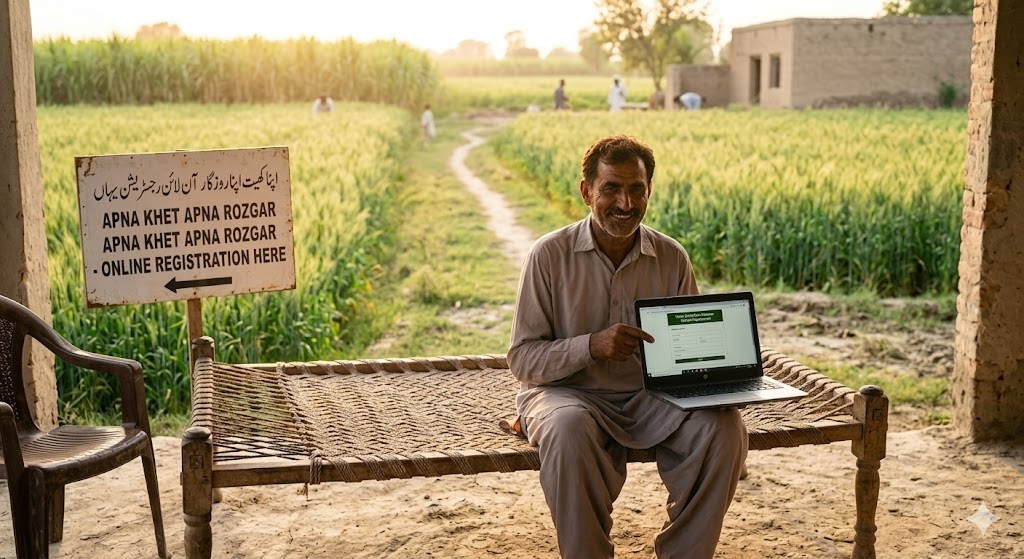
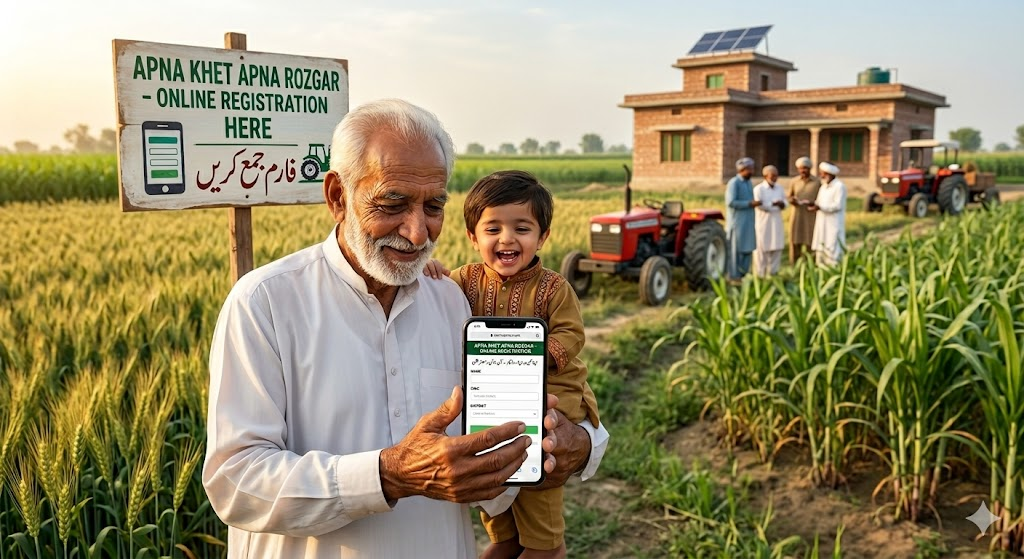
The official portal for apna khet apna rozgar online registration is hosted at akar.pulse.gop.pk, which is a subdomain of the official Punjab government network. The registration process is fully digital and designed to be completed from a smartphone or computer without requiring any in-person visit — though offline options are available for those without internet access.
Step 1 — Access the Official Registration Portal
Navigate to the official government website. Verify that the domain ends in .gov.pk — this is the only guarantee that you are on a legitimate government portal and not a fraudulent imitation site. Many scam websites have appeared mimicking the official AKAR portal to collect personal information and fees. No fee is required for genuine registration.
Step 2 — Create Your Account
Enter your CNIC number and active mobile number to create your login account.
The system will send a one-time password (OTP) to the mobile number you enter. This OTP must be entered to verify your account. As noted above, the mobile number must be registered with NADRA under your CNIC for this step to succeed.
Step 3 — Complete Your Profile
After account creation, log in and complete your detailed profile. This section requires:
- Full name (as on CNIC)
- Father’s name
- Date of birth
- District of residence
- Tehsil and village/revenue estate
- Household size and income details
- Agricultural background and farming skills
- Details of any farming experience
Accuracy at this stage is critical. Any discrepancy between the information in your profile and your official documents will trigger a verification hold or rejection.
Step 4 — Select Your District and Preferred Land Location
Select your district — choose the district where you wish to cultivate land.
Applicants indicate their preferred district for land allocation. Priority is typically given to applicants who are permanent residents of the revenue estate where the land is located. This encourages community-based farming and ensures that allocated land will be cultivated by people with knowledge of local soil, water, and climate conditions.
Step 5 — Upload Required Documents
All documents listed in the previous section must be uploaded as scanned images or clear photographs. The portal specifies acceptable file formats and size limits. Documents that are too large, too small in resolution, or in unsupported formats will not upload correctly.
Best practice is to scan documents at a resolution of at least 300 DPI and save them as JPEG or PDF files under the size limit specified by the portal.
Step 6 — Submit Your Farming Plan
Provide your basic farming plan or agricultural activity details.
This section asks applicants to describe what crops they intend to grow, how they plan to cultivate the land, and how they will use any financial assistance provided. This does not need to be a formal business plan — a clear, honest description of your farming intentions is sufficient. However, applicants who demonstrate genuine knowledge of agricultural practices make a stronger impression during the review process.
Step 7 — Final Submission and Confirmation
Review all entered information carefully before submitting. Once submitted, most portals do not allow editing. After successful submission, you will receive a confirmation message or reference number on your registered mobile number. Keep this reference number safe — it is required for all future communication and status tracking.
Offline Application Option
People who do not have internet access can still apply for the Apna Khet Rozgar scheme by visiting their nearest District Agriculture Office, where officials can assist with the registration process.
This offline pathway is important for ensuring that the scheme reaches rural citizens who may not have reliable internet access or digital literacy. Agriculture department staff at district offices are trained to assist with form completion and document submission.
How the Selection Process Works
One of the most important aspects of this scheme — and one of the main reasons it has generated public confidence — is the transparent selection methodology.
Once applications are received, the government will run a computerised selection process. This means no favouritism, no reference needed, just fair balloting. If you are selected and declared eligible, you will be officially informed with all remaining instructions.
The scale of this scheme is massive. According to official government figures, a total of 43,938 areas have been identified across various districts, while 83,425 areas in Cholistan have been marked, keeping irrigation and fertility factors in view.
The selection timeline for the first phase is structured as follows:
| Phase | Timeline |
|---|---|
| Online registration window | May 2 – May 18, 2026 |
| Appeals window for rejected applicants | June 1 – June 8, 2026 |
| Final beneficiary list publication | June 19, 2026 |
| Land distribution commencement | June 30, 2026 |
The identified land is being divided into mouza-wise agricultural lots of up to five acres, each approved by district collectors.
After the computerized balloting is completed, selected applicants are notified via SMS on their registered mobile number. They are then invited to complete the verification process, which includes a physical visit by a local Patwari and Assistant Commissioner to confirm that the applicant meets all eligibility requirements in person.
The apna khet apna rozgar online registration data serves as the basis for this balloting — meaning the completeness and accuracy of your application directly affects your chances. Incomplete profiles, missing documents, or mismatched information reduce your standing in the selection process.
What Beneficiaries Receive After Selection
The support package provided to successful AKAR Scheme beneficiaries is comprehensive. This is not merely a land lease program — it is a complete agricultural empowerment package.
Agricultural Land Allocation
With 3 to 10 acres of state land, interest-free loans, tractor support, and free training all bundled into one package, the government has made it possible for deserving citizens to turn empty land into real income.
After completing the process, land of up to five acres will be allocated to you on a 10-year lease. A team committee, headed by the Assistant Commissioner, will inspect the land every six months to make sure it is being cultivated properly.
The lease terms are designed to provide long-term security while ensuring that allocated land is actively cultivated. If you fail to pay rent for six months or you leave the land without any cultivation for three continuous years, the lease will be cancelled. These conditions protect the public interest by ensuring allocated land is not left idle or sublet for profit.
Financial Grants and Startup Support
Successful applicants will also receive a Rs 50,000 grant to help start farming immediately.
One-time development grants ranging from Rs 50,000 to Rs 250,000 per acre are provided depending on the land’s condition and the required preparation work. This startup capital covers initial costs like land preparation, irrigation setup, fencing, and first-season inputs.
Kisan Card — Input Subsidy Support
The Kisan Card provides a seasonal credit facility for purchasing seeds, fertilizers, and pesticides. Government-backed subsidies are credited directly to your account with no interest charges on crop inputs purchased through the card. Emergency support is also available during natural disasters like floods or droughts. Over 400,000 farmers across Punjab are already using Kisan Cards, receiving subsidies worth billions of rupees directly without corruption or delays. Farmers report saving 30–40% on input costs.
The Kisan Card integration is particularly valuable because it eliminates the middleman from input procurement. Subsidies flow directly to the farmer’s account, preventing the corruption and price manipulation that have historically plagued government subsidy programs in Pakistan.
Green Tractor Scheme Integration
The Green Tractor Scheme connected with Apna Khet Apna Rozgar provides a tractor subsidy of up to Rs 1,000,000 on new tractors (50–65 HP models), completely interest-free financing for land allottees, subsidies for laser land levelers, seeders, and harvesting equipment, flexible payment schedules aligned with harvest seasons, and access to government-owned machinery for those who don’t need individual tractors.
Modern mechanization is central to the scheme’s vision. A farmer with land but no tractor can only cultivate a fraction of what is possible. By integrating tractor access into the AKAR package, the government significantly increases the potential income each allottee can generate.
Professional Agricultural Training
Government-run agricultural training centers have helped farmers adopt tunnel farming, drip irrigation, and high-value crop cultivation, tripling their per-acre income in some cases.
Training programs cover modern farming techniques including:
- Tunnel farming for off-season vegetables (high value, high demand)
- Drip irrigation systems that dramatically reduce water consumption
- Soil testing and balanced fertilization practices
- Integrated pest management to reduce chemical costs
- Post-harvest handling and storage
- Market access and fair price realization
These training programs transform subsistence-level farmers into commercially-oriented agricultural producers capable of competing in modern markets.
Market Linkage Support
Market linkage support ensures farmers can sell their crops at fair prices. Biannual government inspections guide and support each plot.
Access to markets is often as important as access to land. Many small farmers in Punjab sell their produce at exploitative prices to middlemen because they lack the information, transportation, or bargaining power to access wholesale markets directly. The AKAR Scheme’s market linkage component addresses this structural disadvantage.
Ongoing Agricultural Supervision
Each plot will be supervised by an agriculture officer and an agricultural internee, while a committee comprising Assistant Commissioners and officials from the Agriculture Department will conduct biannual inspections to review cultivation activities.
This supervision structure serves two purposes: it ensures that allocated land is genuinely being cultivated (protecting the public interest), and it provides regular expert guidance to beneficiary farmers who may lack experience with formal agricultural practices.
Important Dates and Deadlines
For applicants currently pursuing apna khet apna rozgar online registration, timing is everything. The first phase has a firm deadline, and late applications are not accepted.
| Event | Date |
|---|---|
| Portal launch | May 2, 2026 |
| Registration deadline (Phase 1) | May 18, 2026 |
| Verification period | May 19 – May 31, 2026 |
| Appeals window | June 1 – June 8, 2026 |
| Final list announcement | June 19, 2026 |
| Land distribution begins | June 30, 2026 |
If you meet the eligibility criteria, applying before the May 18, 2026 deadline through the official portal is the single most important step you can take.
The window for the first phase is narrow — applicants who delay risk losing their opportunity entirely. Even if a second phase is announced later, early applicants who completed apna khet apna rozgar online registration in the first window gain priority standing in the queue.
How to Check Your Application Status
After completing apna khet apna rozgar online registration, applicants can monitor the progress of their application through several channels.
Online Portal Status Check: Log in to the official AKAR portal using your CNIC number and the password you created during registration. Your dashboard will show the current status of your application, including any pending document requirements or verification actions.
SMS Alerts: The portal sends SMS notifications to your registered mobile number at key stages — when your application is received, when it enters verification, when a decision is made, and when you are selected (or not) in the balloting.
District Agriculture Office: Applicants can visit their nearest District Agriculture Office with their CNIC and registration reference number to inquire about the status of their application in person.
Helpline: You can get help by contacting the Agriculture Helpline at 0800-15000 or 0800-29000, or visit the official website, or go to the nearest Agriculture Office in your district.
Helpline: 042-111-111-111.
Critical Mistakes That Lead to Rejection
Understanding what causes rejections can help applicants avoid the most common pitfalls. Thousands of well-intentioned applicants fail to receive benefits every year simply because of avoidable technical errors in their submissions.
When applying for the Apna Khet Apna Rozgar Scheme, avoid these critical errors: Incomplete uploads — missing even one document causes automatic rejection. Blurry scans — unreadable documents delay verification indefinitely. Mismatched CNIC details — name or address discrepancies between CNIC and application form lead to disqualification. Applying with existing land — large landowners are automatically disqualified. Default status — bank loan defaulters cannot apply until clearing debts. Age violations — applicants outside the eligible age range are rejected. Using unofficial portals — only apply through .gov.pk domains to avoid scams. Missing deadlines — late applications are not accepted. Ignoring SMS updates — check mobile regularly for verification requests.
Beyond these technical issues, there are also common strategic mistakes:
Submitting inaccurate information: Some applicants exaggerate their farming experience or understate their land holdings, hoping to improve their selection chances. This is a serious mistake. The verification process involves physical checks by Patwari officials who have access to land records. Inaccurate declarations can result in criminal fraud charges, not just disqualification.
Using agents or middlemen: No private agent, broker, or facilitator is authorized to assist with AKAR applications. No private website or agent is authorized to collect applications or fees. Using unofficial sources can result in fraud or rejection.
Paying fees: The genuine apna khet apna rozgar online registration process is completely free. Any person or website asking for a registration fee is operating a scam.
Selecting the wrong application category: The scheme may include different support categories. Applicants must apply in the category that matches their background and farming needs. Incorrect category selection may lead to rejection.
How to Identify and Avoid AKAR Scams
The popularity of the AKAR Scheme has attracted fraudsters who prey on rural citizens desperate to access the program’s benefits. Protecting yourself requires vigilance.
Signs of a scam:
- Website domain does not end in .gov.pk
- Any request for payment, registration fee, or “processing charge”
- Claims of guaranteed selection in exchange for a fee
- Requests for your complete CNIC details, banking PINs, or biometric data via WhatsApp or phone call
- Unofficial Facebook pages or YouTube channels claiming to offer faster registration
- Agents offering to submit your application “through connections” for a fee
Verification steps:
Always cross-check any communication about the AKAR Scheme against official government sources. The Agriculture Department regularly posts official announcements on its website. Government SMS communications will come from official short codes, not personal mobile numbers.
The apna khet apna rozgar online registration portal is free, accessible directly, and does not require any intermediary. If someone is asking for money to help you apply, they are operating a scam.
The Role of GIS Mapping and Technology
The initiative is being described by officials as a data-driven intervention, relying on GIS-based land mapping and digital systems to identify, allocate, and monitor agricultural land across districts and parts of the Cholistan region.
This technology-first approach is what distinguishes the AKAR Scheme from earlier, paper-based land distribution programs that were vulnerable to corruption. GIS mapping allows the government to:
- Identify all cultivable state land across Punjab with precision
- Map water availability and irrigation proximity for each plot
- Assess soil fertility and agricultural suitability
- Track which plots have been allocated and to whom
- Monitor cultivation activity through satellite imagery over time
The digital infrastructure underlying apna khet apna rozgar online registration extends beyond the application portal. It creates a complete data ecosystem that tracks land, applicants, and cultivation outcomes — enabling the government to measure the scheme’s impact, identify non-compliance, and continuously improve the program.
Cholistan and Special Development Areas
A significant portion of the land available under the AKAR Scheme is located in Cholistan — the desert region in southern Punjab that contains vast tracts of potentially cultivable land if proper irrigation is developed.
83,425 areas in Cholistan have been marked, keeping irrigation and fertility factors in view.
Cholistan presents unique challenges and opportunities. The land is abundant and largely uncultivated, but it requires investment in irrigation infrastructure to become productive. The AKAR Scheme’s integration with broader provincial irrigation programs is intended to address this — channeling resources to bring Cholistan land into productive use while simultaneously creating employment for thousands of landless families.
Applicants interested in Cholistan plots should be aware that:
- Water availability is the primary constraint and is being addressed through new canal and irrigation projects
- Initial cultivation in desert conditions may require different techniques than traditional Punjab farming
- The government provides specialized agricultural training for Cholistan-specific conditions
- Development grants for Cholistan plots may differ from grants for more established agricultural districts
Apna Khet Apna Rozgar vs. Previous Punjab Agricultural Schemes
To appreciate the scope of what apna khet apna rozgar online registration opens the door to, it helps to compare this scheme with earlier government agricultural initiatives in Punjab.
| Feature | Previous Schemes | AKAR Scheme 2026 |
|---|---|---|
| Land provision | Rarely included | Core benefit (3–10 acres) |
| Lease cost | Market rate or above | Rs 100/acre/year (near-free) |
| Selection method | Often manual/political | Computerized balloting |
| Application method | Paper-based / in-person | Fully digital portal |
| Support package | Single benefit (e.g., only loan) | Integrated package (land + loan + machinery + training + market) |
| Beneficiary target | General farmers | Specifically landless and unemployed |
| Scale | Thousands of acres | 250,000+ acres |
| Transparency | Low | High (GIS mapping, digital tracking) |
| Women inclusion | Limited | Explicitly prioritized |
This comparison reveals why apna khet apna rozgar online registration has attracted such unprecedented interest. No previous government scheme in Punjab has combined all of these elements into a single integrated program at this scale.
Impact on Rural Employment and Agricultural Productivity
The economic impact of a successfully implemented AKAR Scheme would be substantial, both at the individual and provincial level.
Individual Level: A family that receives 5 acres of fertile agricultural land under this scheme gains an asset worth approximately Rs 2.5 million to Rs 4 million. With proper cultivation, 5 acres can generate an annual income of Rs 300,000 to Rs 700,000 or more depending on the crops grown and market conditions. This represents a transformation from poverty to the lower-middle class — a genuine, lasting change in economic status.
Community Level: Each successful AKAR Scheme beneficiary who cultivates their allocated land creates additional employment opportunities. Crop cultivation requires seasonal labor, transportation, processing, and marketing — all of which generate income for surrounding community members.
Provincial Level: Government officials remain optimistic that the AKAR initiative will help unlock agricultural potential, generate employment, and reduce rural poverty.
If 50,000 families receive and actively cultivate land under this scheme, Punjab’s agricultural output increases by a measurable amount. Land that was previously sitting idle, contributing nothing to the provincial economy, becomes productive. Tax revenue, supply chains, and rural consumption all benefit.
Post-Allotment Obligations and Land Use Rules
Receiving land under the AKAR Scheme comes with legal obligations that every beneficiary must understand before completing apna khet apna rozgar online registration. Failure to comply with these obligations results in cancellation of the lease.
Cultivation requirement: The allocated land must be actively cultivated. Beneficiaries who fail to cultivate their plot for three consecutive years will lose their allocation.
Rent payment: The lease cost of Rs 100 per acre per year must be paid. While this is an extremely nominal amount, non-payment for six months constitutes grounds for lease cancellation.
No sub-leasing: Beneficiaries cannot sub-lease the allocated land to others. The land must be cultivated personally by the beneficiary or their family.
No permanent construction: Permanent construction is strictly prohibited. Land must be used exclusively for agricultural purposes.
Biannual inspections: Government agriculture officers will conduct regular inspections of each plot. Beneficiaries must cooperate with these inspections and provide cultivation records as required.
No transfer: The land cannot be sold, transferred, or mortgaged. It remains state property leased to the beneficiary for agricultural use.
These obligations are reasonable given that the land belongs to the public and is being made available as a welfare benefit. Understanding them in advance ensures that beneficiaries are not surprised by inspections or rent notices, and that they approach their allocation as a serious long-term agricultural investment.
Helplines and Support Resources
The Punjab government has established several official support channels to assist applicants throughout the apna khet apna rozgar online registration process and beyond.
| Resource | Contact Details | Purpose |
|---|---|---|
| Agriculture Helpline (primary) | 0800-15000 | General scheme queries |
| Agriculture Helpline (secondary) | 0800-29000 | Application assistance |
| AKAR Dedicated Helpline | 042-111-111-111 | AKAR-specific queries |
| District Agriculture Office | In-person at nearest office | Document help, offline applications |
| Assistant Commissioner’s Office | District office | Appeals and verification |
All helplines are toll-free and available during government working hours. Applicants who encounter technical difficulties with the portal, have questions about their eligibility, or need help with document preparation can reach out through any of these channels without paying any fee.
Special Provisions for Women Applicants
The AKAR Scheme includes explicit provisions to promote gender equity in land access — a significant departure from traditional land distribution practices in Pakistan, where women have historically been excluded from formal land ownership.
Both men and women can apply, including widows, divorced women, or disadvantaged applicants.
Women who are the sole breadwinners of their households — particularly widows and divorced women without other income sources — receive priority consideration in the balloting process. This prioritization is designed to address the particular economic vulnerability of these groups, who are statistically among the poorest and most underserved in rural Punjab.
For women completing apna khet apna rozgar online registration, the document requirements are the same as for male applicants. However, in cases where household financial responsibility is demonstrated — for example, through a widow certificate or divorce documentation — these records should be included with the application as they strengthen the case for priority selection.
Integration with Punjab’s Broader Agricultural Development Strategy
The AKAR Scheme does not exist in isolation. It is part of a broader set of agricultural development initiatives launched by the Punjab government under CM Maryam Nawaz Sharif that together form a comprehensive rural economic strategy.
Green Tractor Scheme Phase 3: Alongside the land lease scheme, CM Maryam Nawaz also launched the third phase of the CM Green Tractor Programme. The Chief Minister highlighted that providing modern machinery is essential for improving crop yields. The balloting for these 31,000 tractors has already begun, ensuring transparency in the distribution process.
Kisan Card Program: Already benefiting over 400,000 farmers with direct subsidy access for seeds, fertilizers, and pesticides — and now being extended to AKAR Scheme beneficiaries as a core component of their support package.
Laser Land Leveler Scheme: Providing subsidized access to laser leveling technology that dramatically improves irrigation efficiency and crop yields — a technology that AKAR Scheme beneficiaries with larger plots will benefit from significantly.
Agricultural Training Centers: Expanding province-wide to provide modern farming education in areas including tunnel farming, drip irrigation, and high-value crop cultivation — all directly relevant to AKAR Scheme beneficiaries.
The synergy between these programs means that an AKAR Scheme beneficiary who actively engages with the full range of Punjab government agricultural support can access a comprehensive empowerment package that addresses land, machinery, inputs, training, and markets simultaneously.
Concerns and Challenges
No large-scale government initiative is without challenges, and honest evaluation requires acknowledging the difficulties that may affect the AKAR Scheme’s implementation.
As the scheme moves from planning to implementation, its success is likely to depend on how effectively the government addresses key structural challenges, including water availability, infrastructure development, and safeguards against political interference — factors that will ultimately determine whether the initiative transforms rural livelihoods or falls short of expectations.
Water availability: Many of the identified state lands are in areas with limited irrigation access. Without water, even fertile land cannot be cultivated productively. The government’s parallel investment in irrigation infrastructure will determine whether these plots reach their potential.
Infrastructure gaps: Remote plots require roads, electricity, and storage facilities to be economically viable. Beneficiaries who receive land far from markets or infrastructure will face higher costs and lower returns unless these gaps are addressed.
Agricultural knowledge gaps: Many applicants may have farming experience as laborers but lack the technical knowledge to manage their own farm effectively. The training component of the scheme is critical, but only if it is genuinely delivered at scale.
Political interference risks: While the computerized balloting system is designed to prevent favoritism, implementation at the local level involves human actors who may be subject to political pressures. The GIS-based monitoring and digital audit trail are intended to minimize this risk.
Competition for slots: The competitive selection means not all applicants succeed. Demand is expected to far exceed supply in the first phase. Applicants should prepare psychologically for the possibility that they will not be selected in the first round, and plan to reapply in subsequent phases if they meet the eligibility criteria.
Tips to Maximize Your Chances of Selection
While the selection is ultimately conducted through computerized balloting, there are steps applicants can take to ensure their application is as strong as possible and not eliminated by technical errors.
Complete every field: Partial applications are automatically deprioritized or rejected. Spend the time to fill out every field in the portal accurately and completely.
Upload high-quality documents: Clear, complete scans of all required documents prevent verification delays. Documents that are illegible or incomplete cause processing holds that can result in your application being passed over.
Apply early: While the deadline is fixed, applying early gives you time to notice and correct any errors. Applicants who apply at the last minute have no time to fix problems before the window closes.
Verify your mobile number: The OTP verification step at the beginning of apna khet apna rozgar online registration will fail if your mobile number is not registered against your CNIC in NADRA records. Verify this in advance and update if necessary.
Include supporting evidence of farming background: If you have any documentation of agricultural experience — even informal certificates from local agriculture officials — include it. It strengthens your profile.
Avoid agents: Using an agent wastes money and may result in inaccurate information being submitted on your behalf. The portal is designed for self-service and is straightforward to use with basic literacy.
Keep your reference number: After submitting your application, you receive a reference number. Store this securely — you will need it to check your status, file appeals, and complete the verification process if selected. apna khet apna rozgar apply online punjab
Frequently Asked Questions
What is the official portal for apna khet apna rozgar online registration?
The official portal is akar.pulse.gop.pk, launched by the Government of Punjab. The website allows applicants to submit forms, check eligibility criteria, track application status, and access important updates regarding agricultural loans and support.
Is there any registration fee?
No, there is no application or registration fee for applying to the Apna Khet Apna Rozgar Scheme. Any person, website, or agent asking for payment is operating a scam.
How much land will I receive if selected?
The AKAR Scheme offers landless Pakistani farmers 3 to 10 acres of government land on a 10-year lease at just Rs 100 per acre annually. The exact size of the plot depends on land availability in your district and the allocation determined through the balloting process.
Can I apply if I have never farmed before?
Yes, but relevant knowledge may improve your chances. Applicants without formal farming experience are eligible, but the scheme gives weight to those who can demonstrate an ability to cultivate the land productively. If you have informal farming experience, mention it in your application.
What happens if I am not selected in the first balloting?
Rejected applicants can file an appeal with the Deputy Commissioner during the official appeals window (June 1–8, 2026). Applicants who are not selected in the first phase are expected to be able to reapply when subsequent phases of the scheme are opened.
Can women apply for the scheme?
Yes. Women are explicitly included and encouraged to apply. Widows, single mothers, and women who are the primary earners in their households receive priority consideration in the selection process.
What happens if I don’t cultivate the land after receiving it?
If you fail to pay rent for six months or you leave the land without any cultivation for three continuous years, the lease will be cancelled. The land will then be reallocated to another eligible applicant.
Is permanent construction allowed on the allotted land?
No. Permanent construction is strictly prohibited. Land must be used exclusively for agricultural purposes.
How will I know if I am selected?
You will receive an SMS notification on your registered mobile number. You can also check your status by logging into the official AKAR portal with your CNIC and password.
What crops can I grow on the allocated land?
Agriculture officers assigned to your plot will guide you toward crops best suited to your land type, soil quality, water availability, and local market demand. While you are generally free to choose your crops, guidance from assigned agriculture officers is strongly recommended to maximize your income.
Is the apna khet apna rozgar online registration process available in Urdu?
The official portal offers guidance in both Urdu and English. Applicants with limited English literacy should be able to complete the process in Urdu.
What financial support do beneficiaries receive?
Beneficiaries receive a one-time development grant (Rs 50,000 to Rs 250,000 per acre), access to the Kisan Card for input subsidies, eligibility for the Green Tractor Scheme with up to Rs 1,000,000 subsidy, and interest-free loans for seeds, fertilizers, and farming equipment.
Can I sub-lease the land to someone else?
No. Sub-leasing is strictly prohibited. The land must be cultivated personally by the beneficiary or their immediate family. Violation of this rule results in immediate lease cancellation.
How long is the initial lease period?
The scheme leases cultivable state land for a period of 10 years, which may be renewable based on performance.
Where can I get help if I face problems during application?
You can contact the Agriculture Helpline at 0800-15000 or 0800-29000, or visit the official website, or go to the nearest Agriculture Office in your district.
Summary and Final Guidance
The apna khet apna rozgar online registration process represents a genuinely historic opportunity for landless farmers and unemployed rural youth in Punjab. The scale of land being distributed, the quality of the support package, the transparency of the selection system, and the explicit inclusion of women all mark this scheme as exceptional by the standards of Pakistani rural development policy.
This is not just another announcement — it’s a practical step to fight rural poverty. The Punjab government is giving cultivable state land on a 10-year lease without any rent to deserving people who don’t have their own agricultural land.
But opportunity does not automatically translate into benefit. The apna khet apna rozgar online registration process rewards preparation, accuracy, and promptness. Applicants who gather their documents in advance, verify their NADRA mobile registration, complete every field in the portal honestly, and submit before the May 18, 2026 deadline give themselves the best possible chance of selection.
The integration of apna khet apna rozgar online registration with the Kisan Card, Green Tractor Scheme, and agricultural training programs means that successful applicants are not simply receiving land — they are entering a comprehensive support ecosystem designed to help them build a sustainable agricultural livelihood over the long term.
For anyone who meets the eligibility criteria — particularly landless individuals, unemployed rural youth, and women who are household breadwinners — beginning apna khet apna rozgar online registration immediately is the most important agricultural decision they can make in 2026. The window is narrow, the demand is high, and the potential impact on a family’s economic future is transformative.
Prepare your documents. Verify your mobile number. Log on to the official government portal. Complete every field. Submit before the deadline. And if you face any difficulty, reach out through official helplines — not agents, not unofficial websites, and not anyone asking for a fee.
The land is waiting. The apna khet apna rozgar online registration portal is open. The opportunity is real.